What Is a Discrete Variable? The Hidden Logic Behind Countable Data
In fields where precision matters—whether predicting election outcomes, optimizing supply chains, or training AI models—understanding what is a discrete variable becomes non-negotiable. Unlike continuous data that flows infinitely (height, temperature, time), discrete variables represent distinct, countable categories: the number of customers in a store, the outcome of a coin flip, or the genetic mutations in a DNA sequence. These variables are the bedrock of probability theory, cryptography, and even game theory, yet their subtleties often go unnoticed outside specialized disciplines.
The distinction between discrete and continuous variables isn’t just academic; it dictates the tools you can use. A misclassification—treating a countable variable as continuous—can lead to flawed statistical models, biased predictions, or even catastrophic errors in systems like autonomous vehicles. For example, a self-driving car’s sensor might detect discrete objects (pedestrians, traffic lights) rather than a smooth gradient of pixels. The difference between "three pedestrians" and "3.2 pedestrians" isn’t just semantic; it’s a matter of computational logic.
What makes discrete variables particularly fascinating is their dual role as both abstract concepts and tangible forces. In quantum computing, qubits exist in discrete states (0 or 1), while in epidemiology, discrete variables track the spread of diseases in whole-number increments. Even natural language processing relies on discrete tokenization—converting text into distinct word vectors. Yet, despite their ubiquity, the nuances of what is a discrete variable and how to wield them remain poorly understood outside technical circles.
The Complete Overview of Discrete Variables
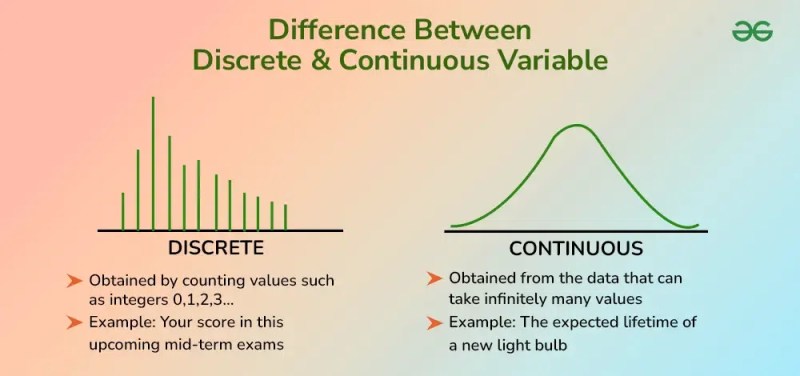
At its core, a discrete variable is one that can assume a finite or countably infinite set of distinct values. This definition may seem straightforward, but its implications ripple across mathematics, engineering, and the sciences. Unlike continuous variables—where values can take any real number within a range (e.g., 3.14159..., 3.1415926535...)—discrete variables are constrained to specific, separable points. For instance, the number of stars in a galaxy is discrete (you can’t have 100.7 stars), while the galaxy’s mass is continuous.The mathematical treatment of discrete variables hinges on combinatorics and difference equations rather than calculus. Probability distributions like the Poisson or binomial are designed specifically for discrete data, where outcomes are mutually exclusive (e.g., a die landing on 1 or 2, but not 1.5). This discreteness also introduces challenges: rounding errors in continuous approximations can distort discrete phenomena, a problem that haunts fields from economics (where transactions are discrete) to biology (where gene counts are whole numbers).
Historical Background and Evolution
The study of discrete variables traces back to the 17th century, when mathematicians like Blaise Pascal and Pierre de Fermat laid the groundwork for probability theory through their correspondence on gambling problems. Their work on the "Problem of Points" (how to fairly divide stakes in an interrupted game) relied entirely on discrete outcomes—winning or losing a hand. Fast forward to the 19th century, and mathematicians like Georg Cantor formalized the concept of countable infinity, proving that discrete sets (like natural numbers) could be infinite yet still "smaller" than continuous sets (like real numbers).The 20th century saw discrete mathematics explode in relevance with the rise of computing. Alan Turing’s discrete-state machines and Claude Shannon’s information theory (where data is quantized into bits) cemented discrete variables as the language of digital systems. Today, discrete mathematics underpins cryptography (RSA encryption relies on discrete modular arithmetic), network routing algorithms, and even the discrete-event simulations used in logistics. The shift from analog to digital technology was, in many ways, a shift toward embracing the power of what is a discrete variable in practical applications.
Core Mechanisms: How It Works
Discrete variables operate under a set of fundamental rules that distinguish them from their continuous counterparts. First, they must satisfy the countability criterion: every possible value can be listed in a sequence, even if that sequence is infinite (e.g., 1, 2, 3, ...). Second, the gap property ensures no intermediate values exist between two adjacent discrete points. For example, between the discrete values 5 and 6, there’s no "5.5" in the domain of the variable.Table of Contents
- The Complete Overview of Discrete Variables
- Historical Background and Evolution
- Core Mechanisms: How It Works
- Key Benefits and Crucial Impact
- Major Advantages
- Comparative Analysis
- Future Trends and Innovations
- Conclusion
- Comprehensive FAQs
- Q: Can a discrete variable have an infinite number of values?
- Q: How do discrete variables differ from categorical variables?
- Q: Why can’t I use continuous probability distributions for discrete data?
- Q: Are there real-world examples where discrete and continuous variables interact?
- Q: How does discretization affect continuous data?
- Q: What role do discrete variables play in machine learning?
- Q: Can discrete variables be negative or zero?
The mechanics of working with discrete variables often involve combinatorial analysis—counting the number of possible outcomes or configurations. A classic example is the binomial coefficient, which calculates how many ways you can choose k successes in n independent trials (e.g., flipping a coin 10 times and getting exactly 6 heads). Discrete probability distributions, such as the geometric or negative binomial, model scenarios where events occur in whole-number increments. Even in physics, discrete variables appear in lattice models (where space is divided into a grid) or in quantum mechanics, where certain observables (like spin) are quantized.
Key Benefits and Crucial Impact
The advantages of discrete variables extend beyond theoretical elegance; they offer practical precision where continuous approximations fall short. In finance, for instance, discrete variables accurately represent the number of shares traded or the count of transactions, avoiding the inaccuracies that would arise from treating them as continuous flows. Similarly, in healthcare, discrete variables track patient outcomes (recovered, stable, critical) with clarity that a continuous "health score" cannot match.Discrete models also excel in scenarios where resources are limited or events are rare. A discrete-event simulation can model a hospital’s emergency room by tracking individual patient arrivals and treatments, whereas a continuous model might smooth over critical bottlenecks. The same principle applies to cybersecurity, where discrete variables represent the number of intrusion attempts or the states of a firewall—each a distinct, actionable data point.
"Discreteness is not just a mathematical quirk; it’s a feature that allows us to model reality with the granularity it demands. In a world of binary choices—open or closed, infected or not—discrete variables are the only language that speaks truth." — Andrew Odlyzko, Mathematician and Computer Scientist
Major Advantages
- Precision in Counting: Discrete variables eliminate rounding errors inherent in continuous approximations, ensuring accurate counts (e.g., inventory levels, population sizes).
- Efficiency in Algorithms: Discrete structures (graphs, trees) enable algorithms like Dijkstra’s shortest-path or Kruskal’s minimum spanning tree to operate with optimal efficiency.
- Clarity in Decision-Making: Binary or categorical discrete variables (e.g., "yes/no," "pass/fail") simplify complex decisions by reducing ambiguity.
- Foundation for Digital Systems: All digital data—from pixels to genetic sequences—relies on discrete representation, making discrete variables the backbone of information technology.
- Robustness in Probabilistic Models: Discrete distributions (Poisson, Bernoulli) are ideal for modeling rare events (e.g., earthquakes, cyberattacks) where continuous distributions would over-smooth probabilities.

Comparative Analysis
Understanding what is a discrete variable requires contrasting it with its counterpart: continuous variables. Below is a side-by-side comparison of their defining characteristics:| Discrete Variables | Continuous Variables |
|---|---|
|
|
Future Trends and Innovations
As data becomes increasingly granular and computational power expands, the role of discrete variables is evolving. One emerging trend is the integration of discrete mathematics with machine learning, particularly in discrete deep learning—where neural networks operate on non-continuous data like graphs or sequences. This approach is revolutionizing fields like drug discovery (modeling molecular interactions) and natural language processing (understanding syntax as discrete structures).Another frontier is quantum discrete systems, where discrete variables govern qubit states in quantum computing. Unlike classical bits, qubits exploit superposition and entanglement, but their measurement outcomes remain discrete—a paradox that challenges and redefines what is a discrete variable in the quantum realm. Additionally, the rise of digital twins—virtual replicas of physical systems—relies heavily on discrete-event modeling to simulate real-world processes with precision.

Conclusion
Discrete variables are more than just a category in statistics; they are the silent architects of modern data-driven systems. From the binary code powering your smartphone to the probabilistic models predicting climate change, the principles of discreteness shape how we interpret and interact with the world. Misunderstanding what is a discrete variable can lead to errors that cascade through entire systems, but mastering it unlocks a toolkit for solving problems where precision is paramount.As technology advances, the boundary between discrete and continuous modeling will blur further, but the fundamental distinction remains critical. Whether you’re analyzing stock markets, designing algorithms, or exploring the quantum universe, discrete variables provide the clarity and structure needed to navigate complexity. The future belongs to those who recognize their power—and wield them wisely.
Comprehensive FAQs
Q: Can a discrete variable have an infinite number of values?
A: Yes, but only if the set is countably infinite. For example, the natural numbers (1, 2, 3, ...) are discrete and infinite, whereas real numbers (e.g., 1.0, 1.1, 1.001...) are continuous and uncountable. The key is whether the values can be put into a one-to-one correspondence with the natural numbers.
Q: How do discrete variables differ from categorical variables?
A: While all discrete variables are categorical in the sense that they represent distinct categories, not all categorical variables are discrete. For instance, "eye color" (blue, green, brown) is categorical but not discrete because it lacks a numerical order. Discrete variables, however, are always numerical (e.g., 1, 2, 3) and can be ordered or used in arithmetic operations.
Q: Why can’t I use continuous probability distributions for discrete data?
A: Continuous distributions (like the normal distribution) assume values can take any real number within a range, which implies a probability density function (PDF). Discrete data, however, requires a probability mass function (PMF), where probabilities are assigned to distinct outcomes. Using a continuous distribution for discrete data (e.g., modeling coin flips with a normal distribution) would assign zero probability to the exact outcomes you care about (e.g., P(heads) = 0).
Q: Are there real-world examples where discrete and continuous variables interact?
A: Absolutely. In finance, the Black-Scholes model (continuous) calculates option prices, but the number of shares traded (discrete) affects execution. In epidemiology, the continuous spread of a virus is modeled alongside discrete patient counts. Even in physics, discrete lattice models approximate continuous fields (e.g., in solid-state physics). Hybrid models are common when one aspect of a system is inherently discrete while another is continuous.
Q: How does discretization affect continuous data?
A: Discretizing continuous data (e.g., rounding temperatures to the nearest degree) introduces quantization error, where fine details are lost. This can distort statistical properties like variance or correlation. For example, discretizing a normal distribution into bins can make it resemble a discrete distribution (like Poisson), altering inference. Techniques like kernel density estimation or binning strategies are used to mitigate these effects while preserving interpretability.
Q: What role do discrete variables play in machine learning?
A: Discrete variables are critical in machine learning for tasks like:
- Classification: Predicting discrete labels (e.g., spam/not spam).
- Count Modeling: Using distributions like Poisson for predicting rare events (e.g., fraud detection).
- Graph Neural Networks: Where nodes and edges are discrete entities.
- Reinforcement Learning: Discrete action spaces (e.g., "move left" or "move right").
Q: Can discrete variables be negative or zero?
A: Yes, but the domain depends on context. For example:
- Non-negative discrete: Counts (e.g., number of customers ≥ 0).
- Signed discrete: Net changes (e.g., stock price movements: +1, -1, 0).
Leave a Comment
Comments are moderated before appearing. The data you submit is processed according to the Privacy Policy of Viralcontentbee.