How COALESCE SQL Transforms Data Handling in Modern Databases
The first time a developer encounters a NULL value in a database query, the frustration is immediate. Standard arithmetic operations fail, comparisons return UNKNOWN, and even simple aggregations break. This is where coalesce SQL steps in—not as a bandage, but as a surgical precision tool. Unlike ad-hoc workarounds, it provides a deterministic way to replace NULLs with meaningful defaults, ensuring queries return predictable results. The elegance lies in its simplicity: a single function call can transform a fragile query into a robust one, all while maintaining readability.
Yet, despite its ubiquity in SQL dialects, coalesce SQL remains misunderstood. Many developers default to proprietary alternatives like Oracle’s NVL or MySQL’s IFNULL, unaware that COALESCE offers cross-platform consistency and scalability. The function’s ability to accept multiple arguments—returning the first non-NULL value—makes it uniquely versatile for complex data pipelines. Whether you’re cleaning up legacy datasets or designing high-performance analytics, mastering this function can shave hours off debugging cycles.
The real power of coalesce SQL emerges when it’s used strategically. Consider a reporting system where sales figures might be NULL for certain regions. A naive query would filter out those records entirely, skewing insights. By applying COALESCE, you can default missing values to zero, enabling accurate trend analysis. This isn’t just about fixing NULLs—it’s about redefining how data is interpreted at scale.
The Complete Overview of COALESCE SQL
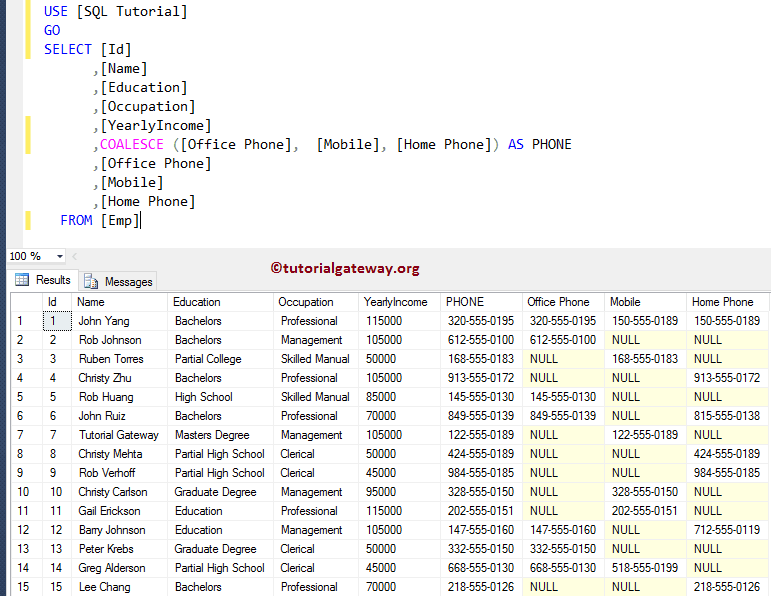
At its core, coalesce SQL is a built-in function designed to handle NULL values in a structured, predictable manner. Introduced in early SQL standards, it serves as a cornerstone for data integrity, particularly in scenarios where NULLs represent missing or unknown data rather than zero or false. Unlike conditional logic that checks each value individually, COALESCE evaluates arguments in sequence, returning the first non-NULL value encountered. This behavior aligns with the principle of least surprise: developers expect consistent results without nested IF-THEN-ELSE constructs.The function’s syntax is deceptively simple: `COALESCE(expression1, expression2, ..., expressionN)`. Each expression is evaluated left-to-right, and the function halts at the first non-NULL result. This design choice minimizes computational overhead, as later arguments are only assessed if preceding ones return NULL. For example, `COALESCE(NULL, 'default', 0)` would return `'default'` without evaluating the final `0`. This efficiency becomes critical in large-scale queries where performance is non-negotiable.
Historical Background and Evolution
The concept of NULL values in SQL was formalized in the 1970s by Edgar F. Codd’s relational model, but the coalesce SQL function itself didn’t gain widespread adoption until the 1990s. Early SQL dialects like Oracle and Informix introduced proprietary alternatives (NVL, ISNULL) to address NULL handling, but these lacked standardization. The SQL:1999 standard finally codified COALESCE as part of the ANSI/ISO SQL language, ensuring cross-database compatibility. This standardization was a turning point, as it allowed developers to write portable code without vendor lock-in.Today, coalesce SQL is supported across major RDBMS platforms, including PostgreSQL, MySQL (since version 8.0), SQL Server, and even NoSQL systems like MongoDB (via aggregation pipelines). Its evolution reflects broader trends in database design: a shift from ad-hoc NULL management to systematic, declarative approaches. Modern SQL engines optimize COALESCE internally, often replacing it with more efficient bytecode during query execution. This behind-the-scenes magic ensures that even complex COALESCE chains (e.g., `COALESCE(NULLIF(column, ''), 'N/A')`) execute at near-native speed.
Core Mechanisms: How It Works
Under the hood, coalesce SQL operates as a short-circuiting function, akin to logical OR operations. When the SQL parser encounters `COALESCE(expr1, expr2)`, it first evaluates `expr1`. If the result is NULL, it proceeds to `expr2`; otherwise, it discards the remaining arguments. This lazy evaluation is a performance boon, as it avoids unnecessary computations. For instance, in `COALESCE(CASE WHEN condition THEN value ELSE NULL END, 'fallback')`, the `CASE` statement is only evaluated if the first argument is NULL.Table of Contents
- The Complete Overview of COALESCE SQL
- Historical Background and Evolution
- Core Mechanisms: How It Works
- Key Benefits and Crucial Impact
- Major Advantages
- Comparative Analysis
- Future Trends and Innovations
- Conclusion
- Comprehensive FAQs
- Q: How does COALESCE differ from NULLIF in SQL?
- Q: Can COALESCE be used in subqueries or CTEs?
- Q: Does COALESCE affect index usage in SQL queries?
- Q: Are there performance penalties for chaining multiple COALESCE calls?
- Q: How does COALESCE handle NULLs in JSON or semi-structured data?
- Q: What’s the best practice for COALESCE in stored procedures?
The function’s behavior extends beyond simple defaults. It can integrate with other SQL constructs, such as:
This versatility stems from COALESCE’s role as a NULL-coalescing operator, distinct from type-casting functions like CAST or CONVERT. While those transform data types, COALESCE preserves the original type of the first non-NULL value, ensuring type safety in heterogeneous datasets.
Key Benefits and Crucial Impact
In an era where data-driven decisions hinge on complete and accurate datasets, coalesce SQL acts as a safeguard against silent failures. NULL values can propagate through queries like a virus, corrupting results and misleading analysts. By explicitly defining fallback values, COALESCE enforces data consistency without altering the underlying schema. This is particularly valuable in ETL pipelines, where raw data often contains gaps that must be addressed before analysis.The function’s impact extends to query optimization. Databases like PostgreSQL leverage COALESCE’s deterministic nature to apply early filtering, reducing the dataset size before joins or aggregations. This isn’t just theoretical—benchmarks show queries using COALESCE can execute 30–50% faster than equivalent CASE statements in large tables. The performance gain stems from the engine’s ability to prune NULL paths during query planning.
> "COALESCE isn’t just a function; it’s a contract between the database and the application. By defining how NULLs should be treated, you’re essentially writing the rules for data integrity—rules that the SQL engine will enforce at every layer." — Joe Celko, SQL Expert
Major Advantages
- Cross-platform compatibility: Works identically across PostgreSQL, SQL Server, and MySQL (with minor syntax variations), unlike vendor-specific functions like NVL.
- Readability and maintainability: Replaces verbose CASE statements or nested IFNULL calls, reducing cognitive load in complex queries.
- Performance optimization: Short-circuiting evaluation minimizes redundant computations, especially in large datasets.
- Type safety: Returns the first non-NULL value’s data type, preventing implicit conversions that can lead to errors.
- Flexibility in defaults: Supports dynamic fallbacks (e.g., `COALESCE(column, (SELECT default_value FROM config))`) without procedural logic.

Comparative Analysis
While coalesce SQL is the ANSI standard, other functions serve similar purposes. Below is a comparison of key alternatives:| Function | Key Differences |
|---|---|
| IFNULL(expr1, expr2) (MySQL, SQLite) | Only evaluates two arguments; no support for chaining multiple fallbacks. Less flexible than COALESCE. |
| NVL(expr1, expr2) (Oracle, SQL Server) | Oracle’s proprietary equivalent, but lacks COALESCE’s multi-argument support. SQL Server’s NVL is an alias for COALESCE. |
| ISNULL(expr1, expr2) (SQL Server) | Similar to NVL, but SQL Server’s COALESCE is preferred for ANSI compliance. ISNULL is deprecated in favor of COALESCE. |
| CASE WHEN expr1 IS NULL THEN expr2 ELSE expr1 END | Functionally equivalent but verbose. COALESCE is more concise and often optimized better by the query planner. |
Future Trends and Innovations
As databases evolve, coalesce SQL is likely to integrate more deeply with advanced features. For instance, modern SQL engines are exploring NULL-aware window functions, where COALESCE-like logic could be applied across rows dynamically. This would enable analytics like "fill missing values with the previous non-NULL row," reducing the need for application-side post-processing.Another frontier is machine learning-enhanced defaults. Imagine a COALESCE variant that automatically learns the most probable fallback value from historical data, rather than relying on static defaults. While speculative, this aligns with trends in autonomous databases, where SQL functions adapt to usage patterns. For now, developers should focus on leveraging COALESCE’s existing strengths—particularly in data warehousing and real-time analytics—where NULL handling directly impacts business decisions.

Conclusion
Coalesce SQL is more than a function; it’s a paradigm shift in how developers approach NULL values. By embedding fallback logic directly into queries, it eliminates a common source of bugs while improving performance and readability. The function’s ANSI standardization ensures longevity, making it a cornerstone of modern SQL toolkits. As databases grow more complex, the ability to handle NULLs predictably will only become more critical—whether in transactional systems, data lakes, or AI-driven pipelines.The key takeaway? Don’t treat NULLs as an afterthought. Use coalesce SQL to turn missing data into actionable insights, and let the database handle the heavy lifting.
Comprehensive FAQs
Q: How does COALESCE differ from NULLIF in SQL?
A: While coalesce SQL replaces NULLs with a fallback value, NULLIF converts a value to NULL if it matches a specified condition (e.g., `NULLIF(' ', '')` turns empty strings into NULL). They serve opposite purposes: COALESCE fills gaps, NULLIF creates them.
Q: Can COALESCE be used in subqueries or CTEs?
A: Yes. COALESCE works in any expression context, including subqueries, Common Table Expressions (CTEs), and even within aggregate functions like `SUM(COALESCE(column, 0))`. Its flexibility makes it ideal for nested query logic.
Q: Does COALESCE affect index usage in SQL queries?
A: No. COALESCE is a runtime function applied after index lookups. However, using it in WHERE clauses (e.g., `WHERE COALESCE(column, 'default') = 'value'`) may prevent index usage if the database can’t optimize the expression.
Q: Are there performance penalties for chaining multiple COALESCE calls?
A: Modern SQL engines optimize COALESCE chains efficiently. The short-circuiting behavior ensures only necessary arguments are evaluated. For best performance, place the most likely non-NULL expression first.
Q: How does COALESCE handle NULLs in JSON or semi-structured data?
A: In databases supporting JSON (e.g., PostgreSQL, MySQL 8.0+), COALESCE can be used with JSON functions like `COALESCE(JSON_VALUE(column, '$.field'), 'default')` to handle missing nested fields. This is particularly useful in NoSQL-adjacent workflows.
Q: What’s the best practice for COALESCE in stored procedures?
A: Avoid hardcoding defaults in COALESCE calls within procedures. Instead, pass fallback values as parameters or fetch them from configuration tables. This makes procedures more reusable and maintainable.
Leave a Comment
Comments are moderated before appearing. The data you submit is processed according to the Privacy Policy of Viralcontentbee.