Java vs. JavaScript: The Critical Difference Between These Tech Giants
The first time developers encounter the difference between Java and JavaScript, confusion is inevitable. Both names share striking similarities—down to the letter "Java"—yet their purposes, architectures, and ecosystems diverge radically. One is a robust, object-oriented powerhouse for enterprise systems; the other is a nimble scripting language that breathes life into web pages. Their overlap in nomenclature has spawned decades of misconceptions, but understanding their core distinctions is essential for architects, engineers, and even non-technical stakeholders navigating the digital landscape.
At its heart, the difference between Java and JavaScript boils down to design philosophy. Java, crafted by Sun Microsystems in the mid-1990s, was engineered as a "write once, run anywhere" language for building standalone applications, servers, and Android apps. JavaScript, meanwhile, emerged as a client-side scripting tool in 1995 to add interactivity to early web browsers—its name a deliberate marketing ploy to leverage Java’s burgeoning popularity. Today, JavaScript dominates frontend development, while Java remains a backbone for backend infrastructure, big data, and cloud-native solutions. Yet their interplay—JavaScript running on servers via Node.js, Java powering Android—creates a symbiotic relationship that shapes the internet’s architecture.
The Java vs. JavaScript debate isn’t just academic; it’s practical. Choosing the wrong tool for a project can lead to performance bottlenecks, scalability issues, or even security vulnerabilities. For instance, a JavaScript-heavy stack might struggle with CPU-intensive tasks, while a Java monolith could become unwieldy for rapid frontend iterations. The lines between them blur further with modern frameworks like Spring Boot (Java) and React (JavaScript), but their fundamental differences persist. This exploration dissects those distinctions—from syntax to use cases—to arm developers with clarity.

The Complete Overview of the Difference Between Java and JavaScript
The difference between Java and JavaScript extends beyond surface-level similarities to encompass language paradigms, execution models, and ecosystem specializations. Java is a statically typed, compiled language that adheres to strict object-oriented principles, while JavaScript is dynamically typed, interpreted, and event-driven. Java’s syntax mirrors C++ and C#, with mandatory semicolons, explicit type declarations, and a class-based structure. JavaScript, by contrast, embraces flexibility: variables can be declared with `var`, `let`, or `const`; types are inferred; and prototypes enable dynamic inheritance. These design choices reflect their intended roles—Java for large-scale, maintainable systems and JavaScript for agile, interactive web experiences.
Execution further highlights the Java vs. JavaScript divide. Java code compiles to bytecode, which runs on the Java Virtual Machine (JVM), ensuring platform independence and performance optimizations like Just-In-Time (JIT) compilation. JavaScript, originally browser-bound, executes in engines like V8 (Chrome) or SpiderMonkey (Firefox), with modern runtimes like Node.js extending its reach to servers. This dichotomy influences performance: Java excels in CPU-bound tasks, while JavaScript thrives in I/O-heavy or asynchronous workflows. Yet both languages now bridge gaps—JavaScript via server-side adoption, Java via scripting capabilities (e.g., Nashorn)—blurring the lines while preserving their core identities.
Historical Background and Evolution
The origins of the difference between Java and JavaScript trace back to the early 1990s, when the internet was transitioning from static documents to dynamic applications. James Gosling and his team at Sun Microsystems developed Java in 1995 as part of the "Green Project," aiming to create a language that could run on embedded systems and consumer devices. Its "write once, run anywhere" philosophy—enabled by the JVM—revolutionized enterprise software, while its integration with the burgeoning World Wide Web (via applets) positioned it as a versatile tool. Meanwhile, JavaScript was born in 10 days at Netscape in 1995 as "LiveScript," renamed to capitalize on Java’s momentum. Brendan Eich’s creation was designed to be simple, lightweight, and embedded directly in HTML, filling a gap for client-side interactivity.
Table of Contents
- The Complete Overview of the Difference Between Java and JavaScript
- Historical Background and Evolution
- Core Mechanisms: How It Works
- Key Benefits and Crucial Impact
- Major Advantages
- Comparative Analysis
- Future Trends and Innovations
- Conclusion
- Comprehensive FAQs
- Q: Can JavaScript run on the JVM?
- Q: Is JavaScript a subset of Java?
- Q: Which language is better for mobile app development?
- Q: Can Java and JavaScript be used together in a single project?
- Q: Why did JavaScript get its name?
- Q: Which language has better performance?
- Q: Are there alternatives to Java and JavaScript?
- Q: How do I decide which language to learn first?
Over the past 25 years, the Java vs. JavaScript landscape has evolved dramatically. Java matured into a full-fledged ecosystem with frameworks like Spring and Hibernate, while JavaScript expanded beyond browsers into backend development (Node.js, 2009), mobile apps (React Native), and even desktop applications (Electron). The rise of JavaScript’s "full-stack" potential—enabled by tools like Express.js and MongoDB—challenged Java’s traditional backend dominance. Yet Java’s strengths in scalability, memory management, and multithreading kept it relevant in industries like finance and big data. Today, both languages coexist in hybrid architectures, with Java often handling heavy lifting (e.g., microservices) and JavaScript managing user-facing logic. Their histories reflect a broader tech trend: specialization and collaboration.
Core Mechanisms: How It Works
Understanding the difference between Java and JavaScript requires examining their execution models. Java’s compilation process begins with source code (`.java` files) being converted to bytecode (`.class` files) by the `javac` compiler. This bytecode is then executed by the JVM, which interprets and optimizes it at runtime. The JVM’s role is critical: it abstracts hardware differences, enabling Java to run on any device with a JVM installation. Key features like garbage collection, multithreading, and strong typing ensure robustness, though they introduce overhead. JavaScript, conversely, is interpreted directly by engines like V8, which parse and execute code line by line. Modern engines employ JIT compilation to optimize hot code paths, but JavaScript’s dynamic nature allows for runtime flexibility—such as adding properties to objects or redefining functions.
The Java vs. JavaScript architectural divide also manifests in memory management. Java’s garbage collector automatically reclaims unused memory, reducing manual intervention but potentially causing latency spikes. JavaScript engines use similar techniques, though their garbage collectors (e.g., V8’s generational approach) are optimized for short-lived objects common in web applications. Another critical difference lies in concurrency: Java’s multithreading model leverages native OS threads, while JavaScript’s single-threaded, event-loop architecture avoids race conditions but requires asynchronous patterns (callbacks, promises, async/await) for I/O operations. These mechanisms underscore their design goals—Java for parallel processing, JavaScript for responsive user interfaces.
Key Benefits and Crucial Impact
The difference between Java and JavaScript isn’t just theoretical; it directly impacts development speed, scalability, and innovation. Java’s strengths lie in its performance, security, and enterprise-grade features, making it ideal for systems where reliability is non-negotiable. Banks, for example, rely on Java for high-frequency trading platforms due to its low-latency capabilities. JavaScript’s advantages—rapid prototyping, cross-platform compatibility, and a vast library ecosystem—have made it the de facto language for web development. Frameworks like React and Angular accelerate frontend development, while Node.js enables backend services with minimal boilerplate. Together, they form the backbone of modern web applications, each addressing a distinct layer of the tech stack.
Beyond technical merits, the Java vs. JavaScript dynamic reflects broader industry trends. Java’s stability and corporate backing (now under Oracle) ensure long-term viability, while JavaScript’s community-driven evolution keeps it agile. The rise of JavaScript’s full-stack potential has democratized development, allowing smaller teams to build end-to-end solutions without specialized backend expertise. Meanwhile, Java’s dominance in Android development and big data (Hadoop, Spark) underscores its role in large-scale systems. Their interplay—Java handling data processing, JavaScript delivering user experiences—illustrates how complementary technologies can coexist and amplify each other’s strengths.
"Java and JavaScript are like two sides of the same coin: one built for the machine, the other for the user. Their synergy defines the modern web’s architecture."
— Brendan Eich, Creator of JavaScript
Major Advantages
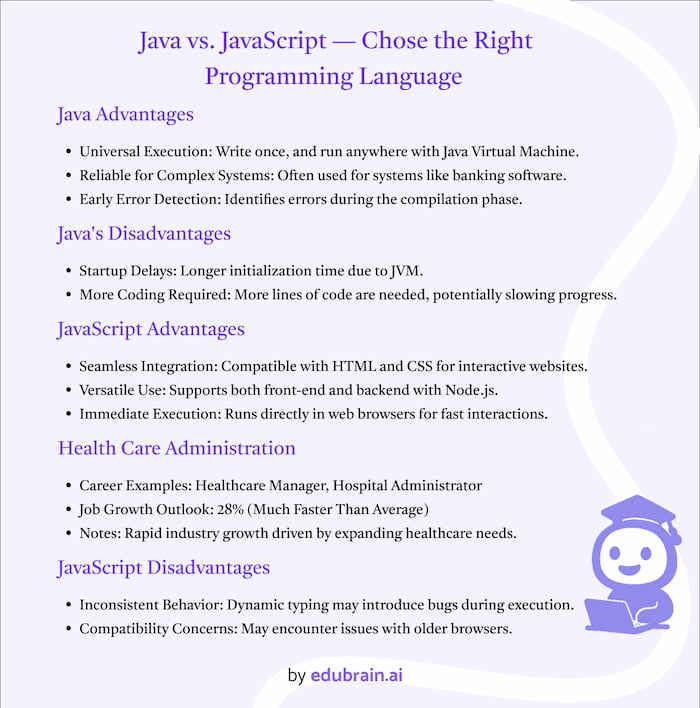
- Java’s Enterprise-Grade Reliability: Strong typing, garbage collection, and JVM optimizations ensure stability in mission-critical applications like banking or healthcare systems.
- JavaScript’s Ubiquity: Runs in every browser and on servers (Node.js), reducing deployment friction for web-based projects.
- Performance for CPU-Intensive Tasks: Java’s compiled nature and multithreading make it superior for data processing, AI, and scientific computing.
- Developer Productivity in Frontend: JavaScript’s dynamic features and frameworks (React, Vue) accelerate UI development with reusable components.
- Cross-Platform Portability: Java’s "write once, run anywhere" principle contrasts with JavaScript’s ability to target multiple platforms via tools like React Native or Electron.
Comparative Analysis
| Aspect | Java | JavaScript |
|---|---|---|
| Typing | Statically typed (explicit types) | Dynamically typed (inferred types) |
| Execution Model | Compiled to bytecode (JVM) | Interpreted (engines like V8) |
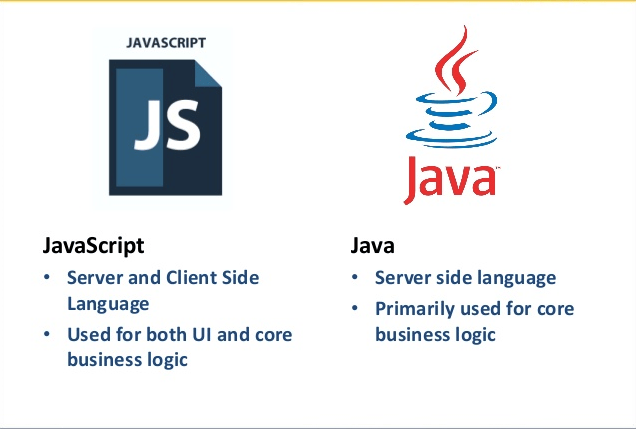
| Primary Use Case | Backend services, Android apps, enterprise software | Frontend interactivity, server-side (Node.js), mobile apps |
| Concurrency Model | Multithreading (native OS threads) | Single-threaded with event loop |
Future Trends and Innovations
The difference between Java and JavaScript will continue to evolve as both languages adapt to emerging paradigms. Java is doubling down on cloud-native development with projects like Quarkus and Micronaut, which optimize for containerized environments. Meanwhile, JavaScript’s future hinges on WebAssembly (Wasm), a binary format that allows languages like Java to run in browsers at near-native speed—potentially bridging the Java vs. JavaScript gap for performance-critical tasks. Additionally, Java’s Project Valhalla aims to introduce value types and primitive classes, while JavaScript’s TC39 committee is exploring features like decorators and topological sorting for modules. These innovations suggest a future where both languages become more versatile, though their core identities—Java for systems, JavaScript for experiences—will likely persist.
Another trend reshaping the Java vs. JavaScript landscape is the rise of hybrid architectures. Tools like GraalVM enable Java and JavaScript to interoperate seamlessly, allowing developers to mix languages within a single application. For example, a Java backend could integrate with a JavaScript frontend via shared APIs, leveraging the strengths of both. As edge computing grows, JavaScript’s lightweight nature will make it ideal for client-side processing, while Java’s robustness will underpin edge servers. The key takeaway? Neither language is disappearing; instead, their roles are specializing further, creating a more modular and efficient tech ecosystem.
Conclusion
The difference between Java and JavaScript is more than a naming quirk—it’s a reflection of their distinct purposes in the digital world. Java’s rigidity and performance make it indispensable for large-scale systems, while JavaScript’s flexibility and ubiquity ensure it remains the language of the web. Their coexistence isn’t competition but collaboration, with each addressing a critical layer of modern software development. As technologies evolve, the lines between them may blur further, but their fundamental differences will endure, shaped by the needs of the applications they serve.
For developers, recognizing these distinctions is crucial. Choosing Java for a high-performance backend or JavaScript for a dynamic frontend isn’t just about syntax—it’s about aligning tools with project requirements. The Java vs. JavaScript debate isn’t about superiority; it’s about understanding when and how to leverage each language’s unique advantages. In an era of polyglot programming, mastery of both opens doors to building more robust, scalable, and innovative solutions.
Comprehensive FAQs
Q: Can JavaScript run on the JVM?
A: Yes, through projects like GraalVM, which allows JavaScript to execute on the JVM, enabling interoperability between the two languages. This bridges the difference between Java and JavaScript by letting them share runtime environments.
Q: Is JavaScript a subset of Java?
A: No. Despite the name, JavaScript was created independently and shares only superficial similarities with Java. The Java vs. JavaScript distinction is fundamental—they have different syntax, execution models, and use cases.
Q: Which language is better for mobile app development?
A: Java is the primary language for Android apps (via Android Studio), while JavaScript powers cross-platform mobile frameworks like React Native. The choice depends on whether you prioritize native performance (Java) or rapid development (JavaScript).
Q: Can Java and JavaScript be used together in a single project?
A: Absolutely. Modern architectures often combine Java for backend services (e.g., Spring Boot) with JavaScript for frontend logic (e.g., React). Tools like REST APIs or GraphQL facilitate seamless integration, leveraging the difference between Java and JavaScript to their advantage.
Q: Why did JavaScript get its name?
A: Netscape renamed LiveScript to JavaScript in 1995 to capitalize on Java’s popularity, despite the languages being unrelated. This marketing decision is a key reason behind the enduring confusion about the difference between Java and JavaScript.
Q: Which language has better performance?
A: Java generally outperforms JavaScript in CPU-bound tasks due to its compiled nature and multithreading. However, JavaScript engines like V8 have optimized significantly, and WebAssembly can now run Java code in browsers at near-native speed, narrowing the gap in specific scenarios.
Q: Are there alternatives to Java and JavaScript?
A: Yes. For backend development, alternatives include Python (Django/Flask), Go, and Rust. Frontend options range from TypeScript (JavaScript’s typed superset) to Dart (for Flutter). However, neither Java nor JavaScript’s ecosystem depth has been fully replicated, making them stalwarts in their domains.
Q: How do I decide which language to learn first?
A: If your goal is web development, start with JavaScript due to its immediate applicability in frontend roles. For enterprise systems, Android, or big data, prioritize Java. Many developers learn both sequentially, as their strengths complement each other in full-stack projects.
Leave a Comment
Comments are moderated before appearing. The data you submit is processed according to the Privacy Policy of Viralcontentbee.