What Is the Difference Between Distance and Displacement? The Hidden Physics Behind Motion
The first time you realize that driving 10 kilometers to the store and back means you’ve traveled 20 kilometers—but your displacement is zero—something fundamental about motion clicks into place. This isn’t just a trick of language; it’s the difference between two pillars of kinematics: distance and displacement. One measures how much ground you’ve covered, while the other tracks where you’ve ended up relative to where you started. The confusion between them persists even among students and professionals, yet mastering this distinction is essential for fields ranging from aerospace engineering to GPS technology.
At its core, what is the difference between distance and displacement boils down to a clash between simplicity and precision. Distance is a straightforward scalar quantity—it tells you how much you’ve moved, regardless of direction. Displacement, however, is a vector, encoding both how much and where. Imagine a hiker who walks 5 kilometers east and then 5 kilometers west: their total distance is 10 kilometers, but their displacement is a neat zero because they’ve returned to the starting point. This isn’t just semantics; it’s the difference between calculating fuel consumption for a road trip and plotting a ship’s course across an ocean.
The implications ripple beyond textbooks. In robotics, a drone’s path planning relies on displacement to correct its trajectory, while distance dictates battery life. In sports analytics, a quarterback’s throwing distance might be celebrated, but their displacement from the line of scrimmage determines play success. Even in everyday life, GPS apps prioritize displacement to reroute you efficiently—because getting back to your car matters more than the total miles you’ve driven.

The Complete Overview of Distance vs. Displacement
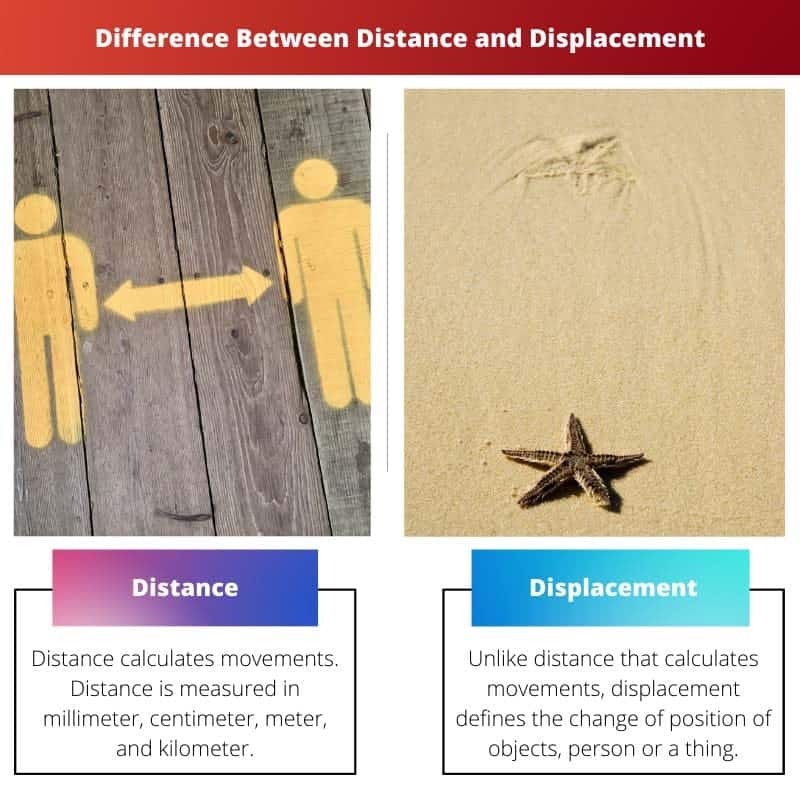
The terms distance and displacement are often used interchangeably in casual conversation, but in physics and engineering, they represent fundamentally different measurements. Distance refers to the total length of the path traveled by an object, irrespective of direction. It’s a scalar quantity, meaning it has magnitude but no directional component. Displacement, on the other hand, is a vector quantity that describes the straight-line separation between an object’s initial and final positions, including both magnitude and direction. While distance is additive (e.g., 3 km + 4 km = 7 km), displacement follows vector addition rules, where directions can cancel each other out.Understanding what is the difference between distance and displacement is critical for analyzing motion accurately. For instance, if a car travels 100 meters north and then 100 meters south, its total distance is 200 meters, but its displacement is zero because it ends up at the starting point. This distinction becomes even more pronounced in three-dimensional spaces, such as in aviation or maritime navigation, where objects move along complex trajectories. Displacement helps in determining the shortest path between two points, while distance provides insight into the energy or effort expended during movement.
Historical Background and Evolution
The conceptualization of distance and displacement traces back to ancient Greek philosophers, who grappled with the nature of motion. Aristotle’s Physics distinguished between quantity of motion (akin to distance) and change of place (closer to displacement), though his ideas were more philosophical than mathematical. The formalization of these concepts, however, emerged during the Scientific Revolution. Galileo Galilei’s work on kinematics in the 17th century laid the groundwork for distinguishing between path length and net displacement, while Isaac Newton’s Principia (1687) codified these ideas into the laws of motion. Newton’s emphasis on vectors—quantities with both magnitude and direction—solidified displacement as a distinct and essential measure in physics.The 19th and 20th centuries saw these concepts evolve alongside technological advancements. The development of calculus by Leibniz and Newton provided the tools to quantify motion precisely, while the rise of engineering in the Industrial Revolution demanded practical applications. In the 20th century, disciplines like aerospace and computer science further refined the use of displacement in navigation systems, robotics, and simulation models. Today, the distinction between distance and displacement is not just academic; it underpins everything from GPS algorithms to autonomous vehicle pathfinding.
Core Mechanisms: How It Works
Distance is calculated by summing the lengths of all segments of a path, regardless of direction. For example, if you walk 5 meters east, then 3 meters north, and finally 4 meters west, your total distance is 5 + 3 + 4 = 12 meters. This is a scalar addition, meaning direction doesn’t affect the result. Displacement, however, requires vector addition. Using the same path, you’d move 5 meters east (displacement: +5i), then 3 meters north (+3j), and finally 4 meters west (-4i). The resultant displacement is calculated as √[(5-4)² + (3)²] = √(1 + 9) = √10 ≈ 3.16 meters northeast. This vector approach accounts for the net change in position.Table of Contents
- The Complete Overview of Distance vs. Displacement
- Historical Background and Evolution
- Core Mechanisms: How It Works
- Key Benefits and Crucial Impact
- Major Advantages
- Comparative Analysis
- Future Trends and Innovations
- Conclusion
- Comprehensive FAQs
- Q: Can displacement ever be greater than distance?
- Q: How is displacement used in real-time GPS tracking?
- Q: Why do physicists emphasize displacement over distance in some calculations?
- Q: Can distance be negative?
- Q: How do athletes use displacement analysis to improve performance?
- Q: What role does displacement play in video game physics engines?
- Q: Is there a relationship between displacement and velocity?
- Q: How do engineers use displacement in bridge construction?
- Q: Can displacement be measured in three dimensions?
- Q: Why might someone confuse distance and displacement in everyday life?
The key to understanding what is the difference between distance and displacement lies in their mathematical treatments. Distance is always non-negative and accumulative, while displacement can be zero (if the object returns to its starting point) or negative (if direction is considered in one-dimensional motion). In physics, displacement is often represented as a vector d = Δx i + Δy j + Δz k, where Δx, Δy, and Δz are the changes in the x, y, and z coordinates, respectively. This vector notation is crucial in fields like fluid dynamics, where understanding the net movement of particles is vital.
Key Benefits and Crucial Impact
The distinction between distance and displacement isn’t merely theoretical—it has profound practical implications across industries. In navigation, for instance, pilots and sailors rely on displacement to determine their position relative to a starting point, while distance helps estimate fuel consumption or travel time. Similarly, in sports, analyzing an athlete’s displacement can reveal inefficiencies in their movement, whereas distance might highlight endurance or speed. Even in everyday activities, such as planning a road trip, understanding displacement ensures you account for the shortest route, while distance informs you about the total miles you’ll cover."Physics is the study of how the universe moves, and displacement is the universe’s way of telling you where it’s gone wrong—or right," remarked theoretical physicist Richard Feynman. This sentiment underscores the importance of displacement in correcting errors in motion. For example, in robotics, a drone’s displacement from its target helps adjust its trajectory, while distance ensures it doesn’t run out of battery power mid-flight. The interplay between these two concepts is what allows machines to navigate complex environments autonomously.
Major Advantages
- Precision in Navigation: Displacement provides the exact position change, critical for GPS, aviation, and maritime travel, where accuracy is non-negotiable.
- Energy Efficiency: Distance helps calculate fuel or battery usage, ensuring optimal resource allocation in vehicles and machinery.
- Error Correction: In robotics and automation, displacement data allows systems to self-correct, improving reliability.
- Sports and Biomechanics: Analyzing displacement reveals movement patterns, aiding in injury prevention and performance optimization.
- Theoretical Foundations: The distinction is essential for advanced physics, from classical mechanics to quantum field theory.

Comparative Analysis
| Aspect | Distance | Displacement |
|---|---|---|
| Type of Quantity | Scalar (magnitude only) | Vector (magnitude + direction) |
| Calculation Method | Sum of all path lengths | Straight-line distance between start and end points |
| Can Be Zero? | No (unless no movement occurs) | Yes (if object returns to start) |
| Real-World Applications | Fuel estimation, step counters, odometers | GPS navigation, robotics, projectile motion |
Future Trends and Innovations
As technology advances, the role of displacement in shaping innovation is becoming increasingly prominent. In autonomous vehicles, for instance, real-time displacement tracking is essential for safe and efficient path planning, especially in urban environments with dynamic obstacles. Similarly, the development of quantum sensors promises to revolutionize displacement measurements, enabling ultra-precise navigation in extreme conditions, such as deep-space exploration or underwater robotics. The integration of machine learning with kinematic data is also poised to enhance predictive modeling, where displacement patterns can forecast future positions with greater accuracy.In the realm of augmented reality (AR) and virtual reality (VR), understanding what is the difference between distance and displacement is critical for creating immersive environments. Users expect seamless transitions between virtual spaces, and displacement calculations ensure that movements in VR align with real-world physics. Additionally, advancements in wearable technology, such as smartwatches and fitness trackers, are leveraging displacement data to provide more nuanced health metrics, moving beyond simple step counts to analyze movement efficiency and posture.
Conclusion
The difference between distance and displacement is more than a semantic quibble—it’s a cornerstone of how we quantify and understand motion. Distance offers a broad, accumulative view of movement, while displacement provides a targeted, directional snapshot. Together, they form the backbone of kinematics, enabling everything from the humble pedometer to the complex algorithms guiding Mars rovers. Ignoring this distinction could lead to errors in navigation, inefficiencies in energy use, or even safety hazards in automated systems.As we continue to push the boundaries of technology, the interplay between these two concepts will only grow in significance. Whether it’s refining the precision of surgical robots or optimizing the routes of delivery drones, the ability to distinguish between how far an object has traveled and how far it has strayed from its origin will remain indispensable. In a world where motion is data, and data is power, mastering this fundamental dichotomy is not just useful—it’s essential.
Comprehensive FAQs
Q: Can displacement ever be greater than distance?
A: No. Displacement represents the shortest straight-line distance between two points, so it can never exceed the total distance traveled. For example, if you walk in a perfect circle and return to your starting point, your displacement is zero, but your distance is the circumference of the circle.
Q: How is displacement used in real-time GPS tracking?
A: GPS systems calculate displacement by comparing the current coordinates of a moving object to its initial position. This allows the system to provide accurate navigation updates, rerouting suggestions, and estimated arrival times based on the net change in position, not just the total miles driven.
Q: Why do physicists emphasize displacement over distance in some calculations?
A: Displacement is often more useful in physics because it accounts for direction, which is critical in analyzing forces, momentum, and energy. For instance, when calculating work done by a force, only the displacement in the direction of the force matters, not the total path length.
Q: Can distance be negative?
A: No, distance is always a non-negative scalar quantity. However, in one-dimensional motion, the change in position (which is a form of displacement) can be negative if the object moves in the opposite direction of a chosen reference axis.
Q: How do athletes use displacement analysis to improve performance?
A: Athletes and coaches analyze displacement to identify inefficient movement patterns. For example, in sprinting, excessive lateral displacement can indicate poor form, while in basketball, a player’s displacement from the basket helps assess shot accuracy. Wearable sensors now track displacement in real time to provide feedback for training.
Q: What role does displacement play in video game physics engines?
A: In video games, displacement is used to simulate realistic movement, collisions, and interactions between objects. For example, a character’s displacement determines whether they’ve crossed a boundary or triggered an event, while distance might dictate how much stamina is consumed during movement.
Q: Is there a relationship between displacement and velocity?
A: Yes. Velocity is the rate of change of displacement with respect to time, making it a vector quantity like displacement itself. Speed, on the other hand, is the rate of change of distance and is scalar. This means velocity considers direction, while speed does not.
Q: How do engineers use displacement in bridge construction?
A: Engineers monitor displacement in bridges to detect structural stress or damage. Sensors measure how much a bridge sags or shifts under load, helping to predict maintenance needs or potential failures before they become catastrophic.
Q: Can displacement be measured in three dimensions?
A: Absolutely. Displacement in 3D space is represented as a vector with components along the x, y, and z axes (e.g., d = Δx i + Δy j + Δz k). This is essential in fields like aerospace, where objects move in all three dimensions simultaneously.
Q: Why might someone confuse distance and displacement in everyday life?
A: In daily contexts, such as driving or walking, the distinction often seems trivial because we rarely return to our starting point. However, in scenarios like hiking or cycling, where direction changes frequently, the difference becomes more apparent. Misunderstanding can lead to overestimating travel time or underestimating the efficiency of a route.
Leave a Comment
Comments are moderated before appearing. The data you submit is processed according to the Privacy Policy of Viralcontentbee.