Mastering JavaScript String Contains: Precision Checks in Modern Development
JavaScript’s ability to check whether one string contains another is foundational for validation, parsing, and data processing. The `includes()` method, introduced in ES6, revolutionized how developers test for substrings by offering cleaner syntax and intuitive behavior. Yet beneath its simplicity lies a spectrum of alternatives—`indexOf`, `match()`, and even regex-based solutions—each with trade-offs in readability, performance, and edge-case handling. Understanding these tools isn’t just about syntax; it’s about selecting the right approach for the task at hand, whether you’re sanitizing user input or parsing complex log files.
The phrase "JavaScript string contains" encapsulates more than a single function call. It represents a decision point: Do you prioritize brevity over legacy support? Should you sacrifice strictness for flexibility? These questions become critical when debugging production systems where a misplaced `contains` check could lead to security vulnerabilities or inefficient queries. Modern frameworks like React and Node.js rely heavily on these operations, yet their behavior under edge cases—Unicode characters, empty strings, or case sensitivity—often surprises developers who assume consistency.
Performance metrics further complicate the choice. While `includes()` excels in most scenarios, its internal implementation may vary across engines (V8, SpiderMonkey). Benchmarking reveals that for large datasets, a well-optimized regex might outperform naive substring checks. The key lies in recognizing that "JavaScript string contains" isn’t a monolithic concept but a toolkit requiring strategic selection.
The Complete Overview of JavaScript String Contains
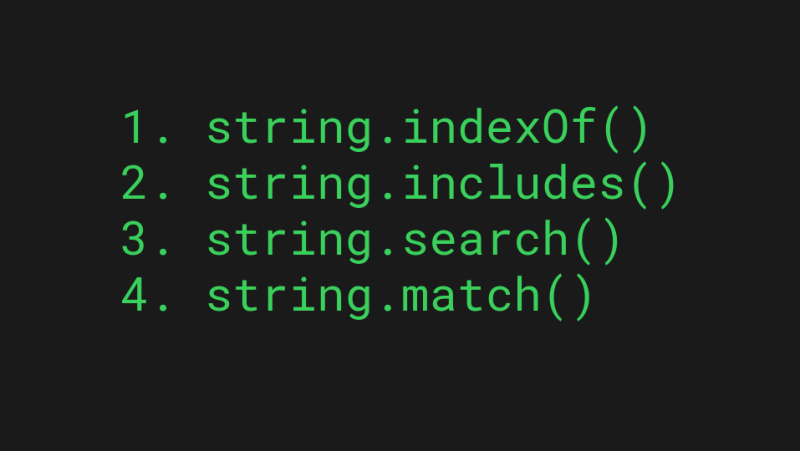
JavaScript provides multiple ways to determine if a string contains another string or pattern, each catering to different use cases. At its core, the `includes()` method offers a straightforward API: `string.includes(searchString, startIndex)` returns `true` or `false` based on presence, with optional position-based searching. This method abstracts away the complexity of `indexOf()`’s `-1` return value, making code more readable. However, its limitations—such as case sensitivity and lack of regex support—demand complementary approaches. For instance, when validating email domains, a case-insensitive check via `toLowerCase()` paired with `includes()` becomes essential, whereas parsing HTML might require regex’s power to match nested structures.Beyond basic containment, JavaScript’s string methods extend to pattern matching. The `match()` function, for example, returns an array of matches (or `null`) when paired with a regular expression, enabling advanced containment checks like validating phone numbers or extracting substrings. Meanwhile, `indexOf()` remains relevant for legacy codebases, though its verbosity (`if (str.indexOf('sub') !== -1)`) contrasts sharply with `includes()`’s elegance. These methods collectively form a hierarchy of precision: from simple substring checks to complex pattern validation, each serving distinct roles in the developer’s toolkit.
Historical Background and Evolution
The evolution of "JavaScript string contains" methods mirrors the language’s broader trajectory toward clarity and performance. Early JavaScript (pre-ES5) relied on `indexOf()` and `lastIndexOf()`, which returned positions or `-1` for absence. This approach forced developers to manually check for `-1`, leading to boilerplate code. The introduction of `includes()` in ES6 (2015) addressed this by standardizing a boolean return value, aligning with modern languages’ emphasis on readability. This shift reflected a broader trend: JavaScript was moving away from low-level bit manipulation toward higher-level abstractions, reducing cognitive load for developers.Under the hood, these methods leverage optimizations specific to each engine. V8, for instance, compiles `includes()` into efficient bytecode for common cases, while SpiderMonkey may prioritize regex performance for `match()`. The trade-off between simplicity and power became apparent as frameworks like Angular and Vue adopted these methods for templating and data binding. Developers now face a choice: stick with familiar `indexOf()` for broad compatibility, or embrace `includes()` for cleaner code, knowing that transpilers like Babel can polyfill older environments.
Core Mechanisms: How It Works
At the lowest level, "JavaScript string contains" operations rely on UTF-16 string encoding and engine-specific optimizations. The `includes()` method, for example, internally converts the search string to a sequence of code units and checks for contiguous matches, handling surrogate pairs correctly in modern engines. This ensures accuracy with Unicode characters like emojis or non-Latin scripts. Under the hood, `indexOf()` performs a similar check but returns the starting index, allowing for further substring extraction if needed. The performance difference between these methods is minimal in most cases, but for large strings (e.g., processing log files), `includes()`’s early termination (stopping at the first match) can offer slight advantages.Table of Contents
- The Complete Overview of JavaScript String Contains
- Historical Background and Evolution
- Core Mechanisms: How It Works
- Key Benefits and Crucial Impact
- Major Advantages
- Comparative Analysis
- Future Trends and Innovations
- Conclusion
- Comprehensive FAQs
- Q: How does `includes()` handle Unicode characters like emojis?
- Q: Can I use `includes()` for case-insensitive checks?
- Q: Why does `indexOf()` return `-1` instead of `false`?
- Q: Is `includes()` faster than `indexOf()`?
- Q: How do I check for multiple substrings at once?
- Q: Does `includes()` work in older browsers like IE11?
- Q: Can I use regex with `includes()`?
Regular expressions introduce another layer of complexity. The `match()` method compiles a regex pattern into a finite automaton, which scans the string for matches. This approach excels at complex patterns (e.g., `"\\d{3}-\\d{2}-\\d{4}"` for SSNs) but incurs overhead for simple checks. The choice between methods thus hinges on the problem’s specificity: use `includes()` for literal substrings, regex for patterns, and `indexOf()` only when legacy support is required.
Key Benefits and Crucial Impact
The adoption of modern "JavaScript string contains" methods has streamlined development workflows, particularly in validation and parsing tasks. Developers spend less time writing defensive checks and more time focusing on logic. For example, sanitizing user input to prevent XSS attacks becomes trivial with `includes()` checks for `
