Mastering ArrayList Methods: The Definitive Technical Breakdown
The ArrayList stands as one of Java’s most versatile data structures, its methods forming the backbone of dynamic array operations. Unlike static arrays, which fix capacity at declaration, ArrayList methods—such as add(), remove(), and get()—enable runtime resizing, iteration, and efficient access. Developers rely on these ArrayList methods to handle variable-length datasets without manual memory management, but their inner mechanics often remain misunderstood. The difference between ArrayList.add() and ArrayList.addAll(), for instance, isn’t just syntactic; it reflects deeper implications for memory overhead and batch processing efficiency.
Yet, for all its flexibility, ArrayList isn’t without pitfalls. Thread-safety issues, resizing costs, and the infamous ConcurrentModificationException plague applications when ArrayList methods are misapplied. High-performance systems—whether in financial trading or real-time analytics—demand precise knowledge of these trade-offs. The choice between ArrayList and alternatives like LinkedList hinges on understanding how methods like get() (O(1)) versus remove() (O(n)) interact with workload patterns. Ignoring these nuances can lead to bottlenecks that static analysis tools often miss.
This analysis dissects the ArrayList methods ecosystem: their historical roots in Java’s collection framework, the low-level mechanics governing resizing and iteration, and their practical impact on scalability. We’ll compare performance benchmarks, debunk common misconceptions, and project how evolving JVM optimizations may reshape their role in modern applications.

The Complete Overview of ArrayList Methods
The ArrayList class, introduced in Java 1.2 as part of the Collections Framework, encapsulates an array-backed list with dynamic resizing. Its methods—public, protected, and utility—abstract away manual array manipulation, offering a seamless interface for adding, removing, and accessing elements. At its core, ArrayList maintains an internal array (elementData) and a size field, where ArrayList methods like trimToSize() or ensureCapacity() directly influence memory allocation. The add() method, for example, triggers a resize when the underlying array is full, doubling its capacity—a strategy balancing amortized O(1) insertion with memory efficiency.
What distinguishes ArrayList from other list implementations (e.g., LinkedList) is its method-level optimization for random access. The get(int index) operation, for instance, leverages direct array indexing (O(1)), whereas remove(int index) requires shifting elements (O(n)). This asymmetry underscores why ArrayList methods are chosen for read-heavy workloads, while LinkedList excels in frequent insertions/deletions at known positions. The trade-off isn’t just theoretical; real-world applications in data processing or game development often pivot on these method-level decisions.
Historical Background and Evolution
The concept of dynamic arrays predates Java, emerging in languages like Lisp and ML as a solution to static array limitations. Java’s ArrayList formalized this idea in 1996, aligning with the framework’s design principles of type safety and encapsulation. Early versions (Java 1.0–1.1) lacked generics, forcing developers to use raw types or casts—a problem later resolved with Java 5’s List<E> interface. The evolution of ArrayList methods mirrors broader JVM advancements: from Vector’s synchronized methods (now deprecated) to ArrayList’s unsynchronized counterparts, offering superior performance at the cost of thread safety.
Table of Contents
- The Complete Overview of ArrayList Methods
- Historical Background and Evolution
- Core Mechanisms: How It Works
- Key Benefits and Crucial Impact
- Major Advantages
- Comparative Analysis
- Future Trends and Innovations
- Conclusion
- Comprehensive FAQs
- Q: Why does ArrayList.add() sometimes take O(n) time?
- Q: How can I avoid ConcurrentModificationException when using ArrayList methods?
- Q: What’s the difference between ArrayList.trimToSize() and ArrayList.trimToCapacity() ?
- Q: Can I use ArrayList methods with primitive types (e.g., int )?
- Q: How does ArrayList.subList() affect performance?
- Q: Are there performance differences between ArrayList.contains() and ArrayList.indexOf() ?
Critical milestones include the introduction of Arrays.asList() (Java 1.4) for array-to-list conversion and the addition of bulk operations like addAll(Collection) (Java 1.2+). These methods reflect a shift toward batch processing, reducing per-element overhead. Modern JVMs further optimize ArrayList methods through escape analysis and inline caching, though developers must still account for legacy constraints—such as the lack of a true "remove by value" method (requiring manual iteration). The class’s stability belies its adaptability, with each method iteration addressing specific use cases, from concurrent access (via CopyOnWriteArrayList) to immutable views (Collections.unmodifiableList()).
Core Mechanisms: How It Works
Under the hood, ArrayList methods operate on a resizable array, where the size field tracks logical length while elementData.length defines capacity. The add(E e) method checks capacity before insertion: if full, it calls grow(), which allocates a new array (typically 1.5x larger) and copies existing elements. This exponential growth minimizes frequent resizing, though it can lead to temporary memory spikes. The get(int index) method performs bounds checking before returning elementData[index], a constant-time operation critical for performance-critical applications.
Removal operations (remove(int index)) introduce complexity: elements must shift left to fill the gap, triggering O(n) time complexity. The remove(Object o) variant iterates linearly to find the element, further amplifying overhead. These mechanics explain why ArrayList methods are suboptimal for frequent deletions—unlike LinkedList, which uses node pointers for O(1) removals. However, ArrayList’s contiguous memory layout enables efficient serialization and cache locality, a trade-off that often favors its use in memory-bound scenarios.
Key Benefits and Crucial Impact
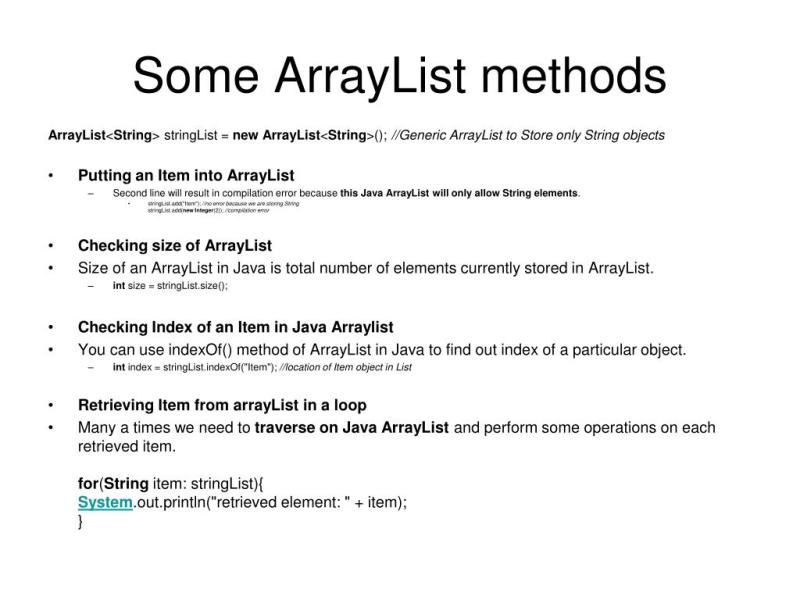
The adoption of ArrayList methods stems from their ability to simplify common operations while maintaining high performance. Developers leverage ArrayList.add() for dynamic collections, ArrayList.get() for indexed access, and ArrayList.contains() for membership checks—all without manual array management. This abstraction reduces boilerplate code, particularly in algorithms requiring frequent resizing, such as pathfinding or financial simulations. The impact extends to interoperability: ArrayList implements List, RandomAccess, Cloneable, and Serializable, ensuring compatibility with frameworks like Spring or Hibernate.
Yet, the benefits of ArrayList methods are not universal. Thread-unsafe operations (e.g., concurrent modifications) demand external synchronization, while memory overhead from resizing can become prohibitive in embedded systems. The choice of method—whether ArrayList.clear() for bulk cleanup or ArrayList.subList() for views—directly affects resource usage. Understanding these trade-offs is essential for architects designing scalable systems, where a poorly chosen ArrayList method can cascade into latency issues or memory leaks.
"The elegance of
ArrayListlies in its simplicity, but its power lies in the details—every method call is a micro-optimization waiting to be exploited or misapplied."
Major Advantages
- Amortized O(1) Insertions: The exponential resizing strategy ensures that
add()operations remain efficient over time, despite occasional O(n) resizing costs. - O(1) Random Access: Direct array indexing via
get()andset()makesArrayListideal for scenarios requiring frequent element retrieval. - Flexible Iteration: Methods like
iterator()andlistIterator()support forward/backward traversal, whileforEach()(Java 8+) enables streamlined processing. - Memory Efficiency for Read-Heavy Workloads: Contiguous storage reduces cache misses compared to linked structures, benefiting performance-critical applications.
- Framework Integration: Seamless compatibility with Java’s Collections API and third-party libraries (e.g., Apache Commons) reduces integration overhead.

Comparative Analysis
| ArrayList Methods | LinkedList Methods |
|---|---|
|
|
Best for: Read-heavy, random-access workloads. |
Best for: Frequent insertions/deletions at known positions. |
Memory: Higher overhead due to resizing; contiguous allocation. |
Memory: Lower overhead for dynamic sizes; non-contiguous nodes. |
Thread Safety: Requires external synchronization. |
Thread Safety: Same; |
Future Trends and Innovations
The future of ArrayList methods hinges on JVM advancements and language evolution. Project Valhalla, for example, may introduce value types that reduce ArrayList’s memory footprint by eliminating object overhead. Meanwhile, Java’s growing emphasis on performance—via GraalVM or ZGC—could further optimize ArrayList resizing, minimizing GC pauses. Developers might also see expanded method support for parallel operations, akin to List.parallelStream(), though thread-safety remains a challenge. Another trend is the rise of immutable collections (e.g., List.of()), which could redefine how ArrayList methods are used in functional programming paradigms.
Looking beyond Java, languages like Kotlin and Scala offer higher-level abstractions (e.g., mutableListOf()) that abstract ArrayList methods entirely. These trends suggest a shift toward declarative APIs, where developers specify what they need rather than how it’s implemented. However, the core mechanics of ArrayList methods—resizing, iteration, and access patterns—will persist as foundational concepts in dynamic array implementations across ecosystems.
Conclusion
ArrayList methods are more than syntactic sugar; they represent a carefully balanced trade-off between performance, flexibility, and simplicity. Their widespread adoption in enterprise and high-frequency applications underscores their role as a cornerstone of Java’s utility libraries. However, the choice to use ArrayList over alternatives should never be arbitrary. Developers must weigh the O(1) access benefits against O(n) removal costs, consider thread-safety implications, and anticipate memory usage patterns. As JVMs evolve, these methods may become even more efficient, but their fundamental principles—resizing, indexing, and iteration—will remain invariant.
The key takeaway is this: ArrayList methods are not a one-size-fits-all solution. They excel in specific contexts—read-heavy, random-access scenarios—but falter where frequent modifications dominate. By mastering their nuances, developers can write code that is not only correct but optimally aligned with the underlying hardware and workload requirements.
Comprehensive FAQs
Q: Why does ArrayList.add() sometimes take O(n) time?
A: The add() method is amortized O(1) due to exponential resizing. When the internal array is full, it triggers a grow() operation that copies all existing elements to a larger array (typically 1.5x capacity), resulting in a temporary O(n) cost. Over many operations, this averages to O(1).
Q: How can I avoid ConcurrentModificationException when using ArrayList methods?
A: This exception occurs when a collection is modified during iteration. Solutions include:
- Using
Iterator.remove()(safe modification during iteration). - Copying the list before iteration (
new ArrayList<>(original)). - Using
CopyOnWriteArrayListfor thread-safe scenarios. - Disabling fail-fast checks via
Collections.synchronizedList()(not recommended for most cases).
Q: What’s the difference between ArrayList.trimToSize() and ArrayList.trimToCapacity()?
A: There is no trimToCapacity() method in ArrayList. The correct method is trimToSize(), which reduces the internal array’s capacity to match the current size, saving memory. This is useful when further additions are unlikely, but it doesn’t affect logical size.
Q: Can I use ArrayList methods with primitive types (e.g., int)?
A: No. ArrayList is generic and requires object types. For primitives, use:
ArrayList(boxing/unboxing overhead).- Primitive-specific arrays (e.g.,
int[]). - Third-party libraries like
Eclipse Collections’sIntList.
Q: How does ArrayList.subList() affect performance?
A: subList() returns a view of the original list, not a copy. Modifications to the sublist (e.g., add()) affect the parent list, and vice versa. This shared-backing structure avoids memory duplication but requires careful handling to prevent unintended side effects. For independent operations, create a new ArrayList via the constructor.
Q: Are there performance differences between ArrayList.contains() and ArrayList.indexOf()?
A: No functional difference—they both iterate linearly (O(n)) to check for an element. However, contains() is a higher-level method that internally calls indexOf(), so there’s no performance gain in using one over the other. For custom objects, override equals() and hashCode() to optimize checks.
Leave a Comment
Comments are moderated before appearing. The data you submit is processed according to the Privacy Policy of Viralcontentbee.