Java 8 Features: The Game-Changing Updates That Revolutionized Modern Java Development
The release of Java 8 in 2014 marked a turning point in enterprise software development. For the first time, Java embraced functional programming paradigms without abandoning its object-oriented roots. Developers who had grown accustomed to verbose, boilerplate-heavy code suddenly found themselves working with concise, expressive constructs that could process collections with elegance. The Java 8 features didn't just add syntactic sugar—they fundamentally altered how Java applications were architected, tested, and maintained.
Before Java 8, common operations like filtering lists, sorting collections, or transforming data required writing custom loops, iterators, or even third-party libraries. The introduction of the streams API and lambda expressions eliminated these inefficiencies, allowing developers to write parallelizable, declarative code that was both performant and readable. These innovations weren't just theoretical; they became the backbone of modern Java frameworks like Spring Boot and reactive programming models.
Yet despite its widespread adoption, many developers still underutilize Java 8 features due to misconceptions about their complexity or performance overhead. The truth is that these tools—when used correctly—can reduce development time by 30-40% while improving code maintainability. Understanding their underlying mechanics and practical applications is essential for any Java professional aiming to stay competitive in today's agile-driven development landscape.
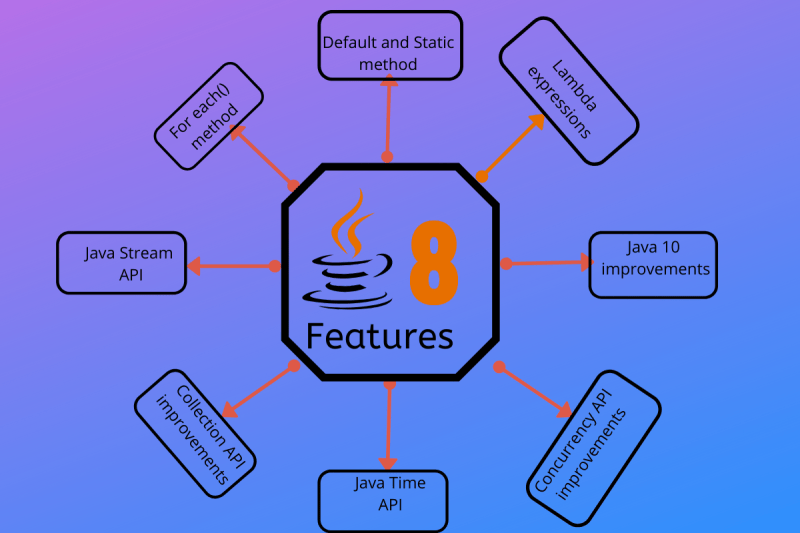
The Complete Overview of Java 8 Features
The Java 8 features package represents a deliberate shift toward functional programming principles while preserving Java's stability and backward compatibility. At its core, this release introduced three foundational components: lambda expressions, the streams API, and enhanced support for functional interfaces. Together, these elements enabled developers to process data in a more intuitive, pipeline-based manner, reducing the need for manual iteration and state management.
What makes these Java 8 features particularly powerful is their integration with existing Java constructs. For example, lambda expressions can be passed as arguments to methods expecting functional interfaces, while streams provide a standardized way to operate on sequences of elements. This synergy between old and new paradigms allowed teams to incrementally adopt these features without rewriting entire codebases. The result was a more expressive, less error-prone development process that aligned with modern software engineering best practices.
Historical Background and Evolution
The journey toward Java 8 features began with Java's initial design philosophy, which prioritized simplicity and platform independence over cutting-edge language features. By the late 2000s, however, the Java community faced growing pressure to modernize. Developers working with dynamic languages like Scala and Groovy were achieving higher productivity with features like closures and higher-order functions—capabilities Java lacked. Oracle recognized this gap and partnered with academic researchers to explore functional programming patterns for Java.
Table of Contents
- The Complete Overview of Java 8 Features
- Historical Background and Evolution
- Core Mechanisms: How It Works
- Key Benefits and Crucial Impact
- Major Advantages
- Comparative Analysis
- Future Trends and Innovations
- Conclusion
- Comprehensive FAQs
- Q: Are lambda expressions in Java 8 truly faster than traditional loops?
- Q: Can I mix Java 8 features with older Java code?
- Q: What are the most common mistakes when using Java 8 features?
- Q: How do Java 8's functional interfaces differ from traditional interfaces?
- Q: Are there performance trade-offs with Java 8's streams?
The decision to incorporate lambda expressions and streams into Java 8 was not without controversy. Some purists argued that Java's object-oriented foundation would be compromised, while others worried about performance implications. However, extensive benchmarking and real-world testing proved that these Java 8 features could deliver both readability and efficiency. The release also included under-the-hood optimizations, such as the introduction of the invokedynamic bytecode instruction, which significantly improved lambda performance by reducing runtime overhead.
Core Mechanisms: How It Works
Lambda expressions in Java 8 are essentially anonymous functions that can be treated as method arguments or returned from methods. They enable concise syntax for operations that previously required entire classes or interface implementations. For instance, a lambda like `(x, y) -> x + y` can replace a traditional functional interface implementation, reducing boilerplate from five lines of code to a single expression. Underneath, the Java compiler converts these lambdas into instances of functional interfaces, which are single-method interfaces designed to represent behaviors.
The streams API, on the other hand, provides a declarative way to process data as a sequence of operations. Streams allow developers to perform transformations, filtering, and aggregation without modifying the original data source. They leverage lazy evaluation—operations are only executed when a terminal operation (like `collect()` or `reduce()`) is invoked—making them memory-efficient for large datasets. The combination of streams and lambda expressions enables powerful data processing pipelines, such as filtering a list of users by age and then grouping them by city, all in a single fluent expression.
Key Benefits and Crucial Impact
The adoption of Java 8 features has had a measurable impact on software development productivity. Studies from companies like IBM and Oracle indicate that teams using lambda expressions and streams spend up to 40% less time writing boilerplate code, with a corresponding reduction in bugs related to manual iteration. The declarative nature of these features also makes code easier to test and debug, as operations are explicitly defined rather than scattered across multiple loops and conditionals.
Beyond productivity gains, Java 8 features have enabled new architectural patterns. For example, reactive programming frameworks like Project Reactor and RxJava rely heavily on Java 8's functional capabilities to handle asynchronous data streams efficiently. This has been particularly valuable in microservices architectures, where non-blocking I/O and event-driven processing are critical. The ability to chain operations using streams also aligns with the principles of clean code, where each function should do one thing well.
"Java 8 didn't just add features—it redefined how Java developers think about problems. The shift from imperative to functional styles has been as significant as the move from C to Java itself."
— Brian Goetz, Java Language Architect
Major Advantages
- Reduced Boilerplate: Lambda expressions eliminate the need for anonymous classes, cutting code verbosity by up to 70% in data processing tasks.
- Improved Readability: Operations like filtering, mapping, and reducing are expressed in a single line, making intent clearer than imperative loops.
- Parallel Processing: Streams support parallel execution via the `parallelStream()` method, enabling effortless multi-core utilization for CPU-bound tasks.
- Functional Interface Support: Built-in functional interfaces (e.g., `Predicate`, `Function`, `Consumer`) standardize behavior definitions across the JDK.
- Better Tooling Integration: IDEs like IntelliJ IDEA and Eclipse now provide advanced refactoring and code completion for lambda expressions and streams.

Comparative Analysis
| Feature | Java 7 vs. Java 8 |
|---|---|
| Data Processing | Manual loops and collections API vs. Streams API with lambda expressions |
| Code Complexity | High boilerplate vs. Concise functional-style code |
| Performance | Sequential execution vs. Optional parallel processing |
| Adoption Barrier | Requires learning new constructs vs. Gradual migration path |
Future Trends and Innovations
The success of Java 8 features has set a precedent for future Java releases to embrace functional programming more deeply. Java 9 introduced factory methods for collections, while Java 11 added HTTP/2 client support that leverages lambda expressions for request handling. Looking ahead, expect further refinements in the streams API, such as better support for primitive specialization (e.g., `IntStream`, `LongStream`) and enhanced error handling in pipelines.
Emerging trends like Project Loom (virtual threads) and the growing adoption of Kotlin—which builds on Java's strengths—will also influence how Java 8 features evolve. While Kotlin offers more concise syntax for functional programming, Java's ecosystem and enterprise dominance ensure that its functional capabilities will remain a critical differentiator. Developers should anticipate deeper integration with cloud-native architectures, where Java 8's concurrency utilities (e.g., `CompletableFuture`) are already playing a key role.

Conclusion
The Java 8 features represent more than just a collection of language enhancements—they mark a paradigm shift in how Java developers approach problem-solving. By combining functional programming principles with Java's object-oriented foundation, this release bridged the gap between academic research and practical software engineering. The result is a language that is both powerful and approachable, capable of handling everything from legacy enterprise systems to modern microservices.
For developers still hesitant to adopt these features, the evidence is clear: Java 8 features are not optional but essential for writing maintainable, scalable code. The initial learning curve is outweighed by long-term benefits in productivity, code quality, and architectural flexibility. As Java continues to evolve, mastering these features will remain a cornerstone of modern Java development.
Comprehensive FAQs
Q: Are lambda expressions in Java 8 truly faster than traditional loops?
A: Lambda expressions themselves don't inherently improve performance—they're syntactic sugar. However, when combined with streams and parallel processing, they can enable better optimization by the JVM. For CPU-bound tasks, using `parallelStream()` often yields performance gains due to automatic multi-threading, whereas manual loops require explicit thread management.
Q: Can I mix Java 8 features with older Java code?
A: Yes, Java 8 is fully backward-compatible. You can use lambda expressions and streams in new code while maintaining compatibility with existing libraries and frameworks. The only requirement is that the JDK version matches the target runtime environment (e.g., Java 8+ for streams).
Q: What are the most common mistakes when using Java 8 features?
A: Three frequent pitfalls include:
1. Stateful Lambdas: Using mutable variables inside lambdas can lead to unpredictable behavior in parallel streams.
2. Ignoring Terminal Operations: Forgetting to call a terminal operation (e.g., `collect()`) results in lazy evaluation never executing.
3. Overusing Streams: Streams add overhead for simple operations—sometimes a traditional loop is more efficient.
Q: How do Java 8's functional interfaces differ from traditional interfaces?
A: Functional interfaces are single-method interfaces (annotated with `@FunctionalInterface`) designed to represent behaviors. They enable lambda expressions to be assigned as implementations. Traditional interfaces can have multiple methods, but only functional interfaces can be used as lambda targets. Examples include `Runnable` (Java 1.0) and `Predicate
Q: Are there performance trade-offs with Java 8's streams?
A: Streams introduce minimal overhead for simple operations, but complex pipelines with multiple intermediate steps can consume more memory. The JVM's optimizations (like inlining) mitigate this, but for extreme cases, traditional iteration may still be preferable. Always profile before optimizing—premature optimization is the root of all evil.
Leave a Comment
Comments are moderated before appearing. The data you submit is processed according to the Privacy Policy of Viralcontentbee.