The Intel vs AMD Battle: Who Leads in Performance, Value, and Innovation?
The Intel vs AMD rivalry has defined modern computing for decades, shaping everything from gaming rigs to data centers. Intel’s dominance in the 1990s and early 2000s was unshaken—until AMD’s Ryzen series arrived in 2017, disrupting the market with multi-core efficiency and competitive pricing. Today, the debate isn’t just about raw speed but about architecture, power efficiency, and long-term value. Intel’s 14th-gen Raptor Lake and AMD’s Ryzen 7000 series represent the latest frontier, where single-threaded performance clashes with multi-threaded prowess, and integrated graphics meet discrete alternatives.
What separates these giants now? Intel’s hybrid architecture leverages performance cores (P-cores) and efficiency cores (E-cores) to balance workloads, while AMD’s Zen 4 cores deliver consistent scaling across threads. The Intel vs AMD dynamic has evolved from a simple speed race to a battle of optimization—where one excels in gaming, the other in productivity, and both vie for the future of AI acceleration. The choice hinges on use case: a content creator might prioritize AMD’s thread count, while a gamer may chase Intel’s frame-per-second edge.
The stakes are higher than ever. AMD’s stock surged post-Ryzen launch, proving consumer demand for alternatives to Intel’s premium pricing. Meanwhile, Intel’s return to leadership in gaming benchmarks (thanks to overclocking and higher clock speeds) has forced AMD to innovate further. This isn’t just about specs—it’s about ecosystems. Intel’s 12th- and 13th-gen platforms required costly motherboard upgrades, whereas AMD’s AM4 socket endured for years, offering longevity at a lower cost. The Intel vs AMD narrative today is less about superiority and more about which chipmaker aligns with your budget, needs, and future-proofing goals.
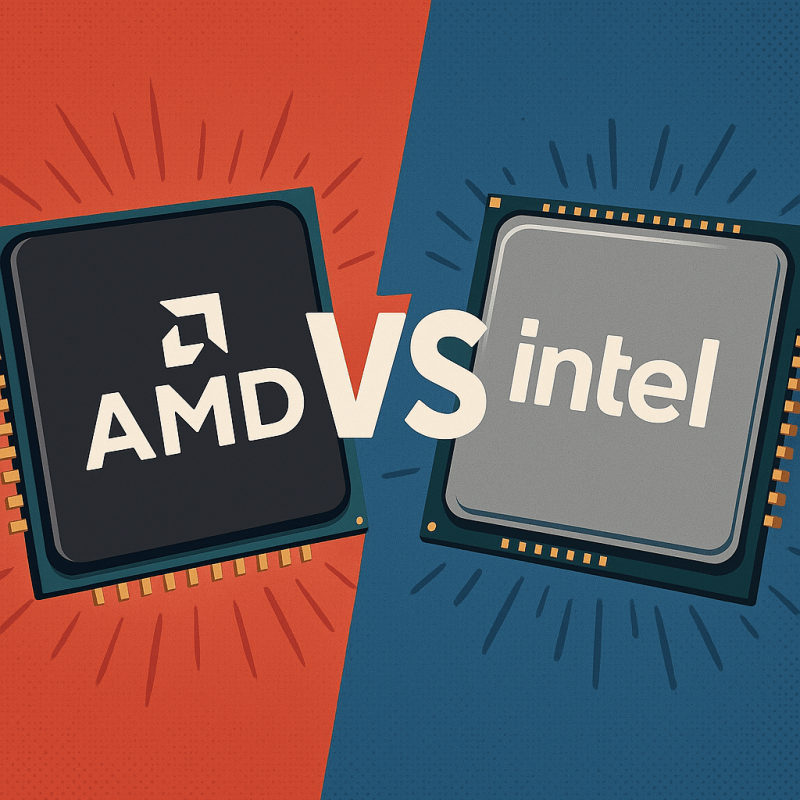
The Complete Overview of Intel vs AMD
The Intel vs AMD landscape is a study in contrasts. Intel, the legacy titan, has long been synonymous with single-threaded dominance, favored by enthusiasts and professionals who demand raw clock speeds. AMD, the underdog turned disruptor, revolutionized the market with Zen architecture, delivering more cores at competitive prices. Today, both companies have refined their approaches: Intel’s hybrid core design (introduced with Alder Lake) aims to merge the best of both worlds, while AMD’s Zen 4 (Ryzen 7000) focuses on efficiency and sustained performance.The Intel vs AMD divide extends beyond desktop CPUs. In laptops, Intel’s Core Ultra series (with NPUs for AI tasks) competes with AMD’s Ryzen 7040, which prioritizes battery life and thermal efficiency. Servers and workstations see Intel’s Xeon and AMD’s EPYC battling for data center supremacy, with AMD’s advantage in core counts and Intel’s edge in single-threaded tasks. The rivalry isn’t just technical—it’s economic. AMD’s aggressive pricing strategy has forced Intel to rethink its positioning, leading to more affordable options like the Core i5-13600K. Meanwhile, AMD’s Ryzen 5 7600 offers near-flagship performance at a fraction of the cost.
Historical Background and Evolution
The Intel vs AMD saga traces back to the 1970s, when Intel’s 4004 processor laid the foundation for modern computing. AMD, founded in 1969, initially focused on memory chips before entering the CPU market in the 1990s with the K5 and K6. The real turning point came in 2003 with AMD’s Athlon 64, which introduced the first x86-64 architecture, setting the stage for 64-bit computing. Intel, however, maintained its lead with Pentium 4 and later Core 2 Duo, solidifying its dominance in both desktop and server markets.The 2010s marked a shift. Intel’s stagnation during the "tick-tock" era (alternating between process shrinks and new architectures) allowed AMD to close the gap with Bulldozer (2011) and later Zen (2017). The Ryzen 7 launch in 2017 was a watershed moment—AMD’s 8-core/16-thread CPU outperformed Intel’s flagship in multi-threaded tasks at a lower price. Intel responded with Coffee Lake (2018), then Cannon Lake and Ice Lake, but it was AMD’s Ryzen 3000 series (2020) that truly redefined the Intel vs AMD dynamic. Today, both companies iterate annually, with Intel’s 14th-gen and AMD’s Ryzen 7000 series pushing boundaries in efficiency and performance.
Core Mechanisms: How It Works
Intel’s hybrid architecture, pioneered with Alder Lake (12th Gen), combines performance cores (P-cores) and efficiency cores (E-cores). P-cores handle demanding tasks like gaming and video editing, while E-cores manage background processes, improving battery life in laptops. This design allows Intel to optimize for both high-end and mainstream users without sacrificing single-threaded performance. For example, the Core i9-14900K features 24 cores (8 P-cores + 16 E-cores), delivering a balance that appeals to content creators and gamers alike.Table of Contents
- The Complete Overview of Intel vs AMD
- Historical Background and Evolution
- Core Mechanisms: How It Works
- Key Benefits and Crucial Impact
- Major Advantages
- Comparative Analysis
- Future Trends and Innovations
- Conclusion
- Comprehensive FAQs
- Q: Which is better for gaming, Intel or AMD?
- Q: Is AMD’s Ryzen 7000 compatible with older motherboards?
- Q: Which CPU is better for content creation, Intel or AMD?
- Q: Does Intel still have an advantage in workstations?
- Q: Are there any major downsides to AMD’s Ryzen 7000?
- Q: How does Intel’s hybrid architecture compare to AMD’s uniform cores?
- Q: Can I upgrade from an Intel CPU to AMD or vice versa?
- Q: Which brand offers better value for money?
- Q: How important is integrated graphics in today’s CPUs?
- Q: What’s the future of the Intel vs AMD rivalry?
AMD’s Zen 4 architecture, underpinning Ryzen 7000, takes a different approach. It emphasizes core efficiency and sustained performance, with all cores (up to 16 in the Ryzen 9 7950X) operating at similar frequencies. AMD’s Precision Boost 5 dynamically adjusts clock speeds based on workload, ensuring consistent performance without thermal throttling. Additionally, AMD’s 3D V-Cache technology (seen in the Ryzen 7 7800X3D) stacks L3 cache vertically, reducing latency and boosting gaming performance by up to 15%. This innovation highlights AMD’s focus on real-world impact over theoretical benchmarks.
Key Benefits and Crucial Impact
The Intel vs AMD rivalry has reshaped the tech industry, driving innovation in CPU design, pricing, and ecosystem support. Intel’s legacy in single-threaded performance remains unmatched, particularly in gaming and professional applications where low latency is critical. AMD, meanwhile, has democratized high-core-count processing, making workstation-level performance accessible to mainstream users. The competitive pressure has also accelerated advancements in manufacturing processes—both companies now use TSMC’s 3nm and 5nm nodes, reducing power consumption and improving efficiency.This rivalry extends beyond consumers. Data centers rely on AMD’s EPYC processors for their core density and power efficiency, while Intel’s Xeon dominates in enterprise workloads requiring high single-threaded performance. The Intel vs AMD battle has also influenced motherboard and chipset development, with AMD’s AM5 platform offering PCIe 5.0 support and DDR5 compatibility, while Intel’s 17th-gen platforms promise further upgrades. The impact is measurable: AMD’s market share has surged from under 10% in 2017 to over 30% in 2023, a testament to its disruptive strategy.
"AMD didn’t just compete with Intel—they redefined what consumers expect from a CPU. The Ryzen launch wasn’t just a product; it was a statement that performance doesn’t have to come with a premium price tag."
— Linus Sebastian, Tech YouTuber and Engineer
Major Advantages
- Intel’s Strengths:
- Superior single-threaded performance, critical for gaming and latency-sensitive applications.
- Hybrid core architecture (P-cores + E-cores) balances high-end and efficiency tasks.
- Strong overclocking potential, especially in the Core i9 and i7 series.
- Wider compatibility with legacy software optimized for Intel architectures.
- Leadership in integrated graphics (Iris Xe), reducing the need for discrete GPUs in budget builds.
- AMD’s Strengths:
- Better multi-threaded performance, ideal for content creation and productivity.
- More cores for the price, offering better value in workstation and server markets.
- 3D V-Cache technology (e.g., Ryzen 7 7800X3D) provides a significant gaming advantage.
- Longer platform support (e.g., AM4 socket lasted 7 years), reducing upgrade costs.
- Strong ecosystem for enthusiasts, including robust BIOS updates and third-party cooling support.

Comparative Analysis
| Category | Intel (14th Gen) | AMD (Ryzen 7000) |
|---|---|---|
| Architecture | Hybrid (P-cores + E-cores) | Zen 4 (Uniform cores) |
| Single-Threaded Performance | Leads in gaming and latency-sensitive tasks | Strong but slightly behind in pure single-threaded benchmarks |
| Multi-Threaded Performance | Good, but limited by core count in mainstream chips | Excels with higher core/thread counts (e.g., Ryzen 9 7950X) |
| Power Efficiency | Improved with E-cores, but P-cores can be power-hungry | Better overall efficiency, especially in Zen 4 |
| Platform Longevity | Frequent upgrades (LGA 1700 → 1851), higher motherboard costs | AM5 socket supports future upgrades, lower entry cost |
| Gaming-Specific Tech | Higher clock speeds, better for FPS in competitive titles | 3D V-Cache (e.g., 7800X3D) offers latency advantages in some games |
Future Trends and Innovations
The Intel vs AMD race is far from over. Intel’s 14th-gen Raptor Lake and upcoming Meteor Lake (for laptops) will push hybrid architecture further, while Arrow Lake (2024) may introduce AI-specific cores. AMD’s next-gen Zen 5 (expected in 2024) could refine efficiency further, potentially matching Intel’s single-threaded performance while maintaining multi-threaded dominance. Both companies are also investing heavily in AI acceleration—Intel with its NPUs (Neural Processing Units) and AMD with its CDNA architecture for data centers.Beyond CPUs, the battle extends to GPUs. Intel’s Arc series competes with AMD’s Radeon, though adoption remains low. In the server space, AMD’s EPYC Milan and Genoa have made inroads against Intel’s Xeon, particularly in cloud computing. The Intel vs AMD dynamic will likely intensify with the rise of heterogeneous computing, where CPUs, GPUs, and NPUs work in tandem. AMD’s acquisition of ARM IP and Intel’s collaboration with TSMC for advanced nodes suggest a future where both companies leverage external expertise to stay ahead.

Conclusion
Choosing between Intel and AMD in 2024 depends on your priorities. Gamers may lean toward Intel’s higher clock speeds, while content creators will favor AMD’s core counts and efficiency. Budget-conscious buyers benefit from AMD’s value proposition, whereas enthusiasts might prefer Intel’s overclocking potential. The Intel vs AMD rivalry has never been more dynamic, with each company pushing boundaries in architecture, pricing, and innovation.The next few years will be critical. Intel’s ability to sustain its hybrid advantage and AMD’s execution of Zen 5 will determine who leads the next generation. One thing is certain: the Intel vs AMD debate ensures that consumers always have compelling options, driving the industry forward.
Comprehensive FAQs
Q: Which is better for gaming, Intel or AMD?
Intel generally leads in gaming due to higher clock speeds and optimized single-threaded performance. However, AMD’s Ryzen 7 7800X3D (with 3D V-Cache) outperforms many Intel CPUs in select titles like Cyberpunk 2077 and Star Citizen. For most games, Intel’s Core i5-14600K or i7-14700K are top choices, but AMD’s Ryzen 7 7700X offers near-flagship performance at a lower price.
Q: Is AMD’s Ryzen 7000 compatible with older motherboards?
No, AMD’s Ryzen 7000 series requires a new AM5 motherboard due to DDR5 and PCIe 5.0 support. However, AMD’s AM4 socket (used by Ryzen 5000) remains compatible with older B450/B550 boards, offering a cost-effective upgrade path for non-DDR5 systems.
Q: Which CPU is better for content creation, Intel or AMD?
AMD typically excels in content creation due to higher core/thread counts. For example, the Ryzen 9 7950X (16 cores/32 threads) outperforms Intel’s Core i9-14900K (24 cores but fewer P-cores) in multi-threaded tasks like video rendering. However, Intel’s hybrid architecture can be efficient for lighter workloads, such as photo editing with Adobe Lightroom.
Q: Does Intel still have an advantage in workstations?
Intel maintains an edge in workstations for applications relying on single-threaded performance, such as CAD (AutoCAD, SolidWorks) and scientific computing. However, AMD’s EPYC processors dominate in server and data center workloads, offering better core density and power efficiency for virtualization and AI tasks.
Q: Are there any major downsides to AMD’s Ryzen 7000?
Yes. AMD’s Ryzen 7000 series requires DDR5 RAM, which can be expensive, especially for high-capacity kits. Additionally, the AM5 platform lacks PCIe 4.0 support, which may limit future GPU upgrades. Intel’s 17th-gen platforms (expected in 2024) could also introduce new features that make AMD’s AM5 less future-proof.
Q: How does Intel’s hybrid architecture compare to AMD’s uniform cores?
Intel’s hybrid design (P-cores + E-cores) is optimized for tasks that benefit from high single-threaded performance (e.g., gaming) while offloading background tasks to E-cores. AMD’s uniform cores provide consistent performance across all threads, which is better for sustained workloads like rendering or compiling code. Intel’s approach is more flexible for mixed-use scenarios, while AMD’s is more efficient for pure productivity.
Q: Can I upgrade from an Intel CPU to AMD or vice versa?
Switching between Intel and AMD requires a complete platform change. Intel uses LGA sockets (e.g., LGA 1700 for 12th/13th Gen), while AMD uses AM sockets (e.g., AM5 for Ryzen 7000). Motherboards, RAM, and sometimes even cooling solutions are incompatible. Always check compatibility before upgrading.
Q: Which brand offers better value for money?
AMD generally provides better value, especially in the mid-range. For example, the Ryzen 5 7600 (6 cores/12 threads) competes with Intel’s Core i5-14600K (14 cores) but at a significantly lower price. Intel’s value proposition improves in high-end segments (e.g., i9-14900K), but AMD’s Ryzen 7 7800X3D often delivers near-flagship performance for less.
Q: How important is integrated graphics in today’s CPUs?
Integrated graphics (iGPUs) are less critical now due to affordable GPUs, but they remain useful for budget builds, office tasks, and light gaming. Intel’s Iris Xe graphics (found in Core i5/i7/i9) are stronger than AMD’s Radeon Graphics (Ryzen 5/7), but neither can replace a dedicated GPU for modern titles.
Q: What’s the future of the Intel vs AMD rivalry?
The rivalry will likely focus on AI integration, with both companies adding NPUs or AI-specific cores. Intel’s Arrow Lake (2024) and AMD’s Zen 5 (2024) may blur the lines further, with hybrid architectures on both sides. AMD’s focus on efficiency and Intel’s single-threaded dominance will continue, but innovations like 3D stacking (AMD) and advanced packaging (Intel) could redefine performance benchmarks.
Leave a Comment
Comments are moderated before appearing. The data you submit is processed according to the Privacy Policy of Viralcontentbee.