How AWS ECS Transforms Modern Container Orchestration
The transition from monolithic architectures to distributed systems has reshaped how applications are built, deployed, and scaled. At the heart of this evolution lies AWS ECS, a container orchestration service that bridges the gap between raw infrastructure and application logic. Unlike legacy systems requiring manual server management, AWS ECS abstracts the underlying complexity, allowing developers to focus on code while AWS handles the heavy lifting—scheduling, scaling, and load balancing. This shift isn’t just about efficiency; it’s about redefining operational agility in an era where downtime isn’t an option.
Yet, despite its prominence, AWS ECS remains misunderstood. Many associate it solely with Docker containers, overlooking its hybrid capabilities—supporting both Docker and AWS Fargate, a serverless execution model. The service’s true power lies in its flexibility: it can run on EC2 instances for granular control or leverage Fargate for zero-maintenance deployments. This duality makes it a cornerstone for enterprises migrating legacy workloads while enabling startups to innovate without infrastructure overhead.
The rise of AWS ECS mirrors the broader industry shift toward cloud-native development. Traditional on-premises data centers, with their rigid scaling limits and manual interventions, are being phased out in favor of dynamic, event-driven architectures. AWS ECS sits at the intersection of this transformation, offering a managed solution that eliminates the need for Kubernetes clusters while retaining core orchestration features. But how did it get here?

The Complete Overview of AWS ECS
AWS ECS (Elastic Container Service) is Amazon’s native container orchestration platform, designed to simplify the deployment, management, and scaling of containerized applications. Unlike Kubernetes, which requires extensive operational expertise, AWS ECS integrates seamlessly with AWS’s broader ecosystem—VPC, IAM, CloudWatch, and Lambda—reducing the learning curve for teams already invested in AWS. Its architecture is built around two primary modes: ECS with EC2 (for cost-sensitive, high-performance workloads) and ECS with Fargate (for serverless, pay-per-use deployments). This duality ensures that teams can optimize for either control or convenience, depending on their needs.The service’s appeal lies in its balance of simplicity and functionality. Developers define their application’s requirements—CPU, memory, networking—via task definitions, while AWS ECS handles the rest: resource allocation, failover recovery, and load distribution. This abstraction isn’t just about convenience; it’s a strategic move to reduce operational toil. For example, a microservices architecture spanning 50 containers can be managed as a single unit, with AWS ECS automatically rerouting traffic during failures or scaling tasks based on demand. The result is a system that scales horizontally without the complexity of Kubernetes’ steep learning curve.
Historical Background and Evolution
AWS ECS was launched in 2014 as a response to the growing adoption of Docker and the need for a managed container service. Initially, it supported only Docker containers, but by 2016, AWS introduced ECS with Fargate, a serverless compute engine that eliminated the need to manage underlying infrastructure. This innovation was pivotal, as it allowed developers to focus solely on application logic while AWS handled the infrastructure. The service’s evolution continued with features like AWS App Mesh integration (2018) for service mesh capabilities and AWS Copilot (2021) for simplified CLI-based deployments.The shift toward serverless containers wasn’t just about convenience—it was a strategic pivot. Traditional container orchestration tools like Kubernetes demanded significant operational overhead, including cluster management, node scaling, and networking configuration. AWS ECS addressed these pain points by offering a fully managed experience, where AWS abstracted away the infrastructure layer. This approach resonated with enterprises seeking to modernize their stacks without the complexity of Kubernetes, while still benefiting from containerization’s scalability and portability.
Core Mechanisms: How It Works
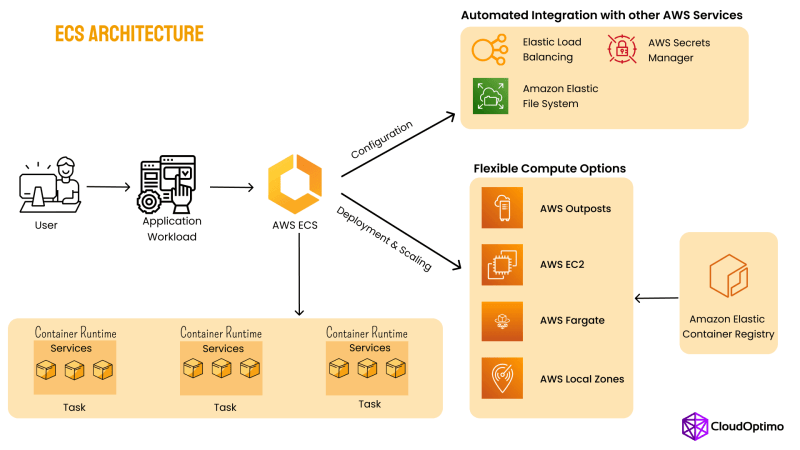
At its core, AWS ECS operates on a simple yet powerful principle: tasks (groups of containers) are scheduled onto containers instances (EC2 hosts or Fargate) based on defined resource requirements. When a task is launched, AWS ECS pulls the specified Docker image from a registry (e.g., Amazon ECR), injects it into a container, and assigns it to an instance with available resources. The service then monitors the task’s health, restarting failed containers automatically and replacing them if necessary.Table of Contents
- The Complete Overview of AWS ECS
- Historical Background and Evolution
- Core Mechanisms: How It Works
- Key Benefits and Crucial Impact
- Major Advantages
- Comparative Analysis
- Future Trends and Innovations
- Conclusion
- Comprehensive FAQs
- Q: How does AWS ECS differ from Kubernetes?
- Q: Can AWS ECS run non-Docker containers?
- Q: What is the cost difference between ECS with EC2 and Fargate?
- Q: Does AWS ECS support GPU acceleration?
- Q: How secure is AWS ECS compared to other orchestration tools?
The architecture leverages AWS Fargate for serverless execution, where tasks run in isolated environments without requiring EC2 instances. This model is particularly advantageous for sporadic workloads, as teams pay only for the compute time consumed. For EC2-based deployments, AWS ECS integrates with Auto Scaling Groups to dynamically adjust the number of instances based on demand. Additionally, ECS Cluster Auto Scaling ensures that tasks are distributed efficiently across available resources, optimizing cost and performance.
Key Benefits and Crucial Impact
The adoption of AWS ECS isn’t merely a technological upgrade—it’s a paradigm shift in how organizations approach application deployment. By eliminating the need to manage underlying infrastructure, AWS ECS reduces operational complexity, allowing teams to iterate faster and deploy with confidence. This is particularly critical in industries where uptime and performance are non-negotiable, such as fintech, healthcare, and e-commerce. The service’s integration with AWS’s broader ecosystem further enhances its value, enabling seamless connectivity with databases, APIs, and other cloud services.One of the most compelling aspects of AWS ECS is its ability to democratize container orchestration. Teams without Kubernetes expertise can still leverage containerization’s benefits, thanks to AWS ECS’s intuitive interfaces and managed services. For example, a development team can deploy a new microservice in minutes using AWS Copilot, without needing to configure Kubernetes manifests or manage etcd clusters. This accessibility has made AWS ECS a preferred choice for startups and enterprises alike, bridging the gap between innovation and operational stability.
> "AWS ECS is more than a container service—it’s a platform that redefines how applications are built and scaled. By abstracting infrastructure, it allows teams to focus on what matters most: delivering value to users." — AWS Senior Solutions Architect
Major Advantages
- Simplified Orchestration: Eliminates the need for Kubernetes clusters, reducing setup and maintenance overhead. AWS ECS handles scheduling, load balancing, and scaling automatically.
- Hybrid Deployment Models: Supports both EC2 (for cost control) and Fargate (for serverless simplicity), allowing teams to choose the best fit for their workload.
- Seamless AWS Integration: Works natively with VPC, IAM, CloudWatch, and other AWS services, enabling tight security and observability.
- Cost Efficiency: With ECS with Fargate, teams pay only for the compute resources consumed, making it ideal for variable workloads.
- Enhanced Security: Leverages AWS’s native security features, including IAM roles for tasks, VPC isolation, and encrypted storage for container images.

Comparative Analysis
| Feature | AWS ECS | Amazon EKS (Kubernetes) |
|---|---|---|
| Learning Curve | Low (managed service, minimal configuration) | High (requires Kubernetes expertise) |
| Deployment Models | EC2 or Fargate (serverless) | EC2 or Fargate (with Kubernetes control plane) |
| Scalability | Automatic scaling via ECS Cluster Auto Scaling | Manual or automated via Kubernetes HPA |
| Cost Structure | Pay for EC2 instances or Fargate compute time | Pay for EKS control plane + EC2/Fargate costs |
Future Trends and Innovations
The future of AWS ECS is closely tied to the broader evolution of cloud-native computing. As serverless architectures gain traction, AWS ECS is likely to expand its Fargate capabilities, offering even finer-grained resource allocation and event-driven scaling. Additionally, tighter integration with AWS Lambda could enable hybrid workloads where containers and serverless functions coexist seamlessly, further blurring the lines between traditional and modern architectures.Another key trend is the rise of multi-cloud container orchestration, where AWS ECS may incorporate hybrid cloud features to allow workloads to span AWS and other cloud providers. This would address a common pain point: vendor lock-in. Meanwhile, advancements in AI-driven orchestration could automate task placement and scaling based on predictive analytics, reducing human intervention even further. As AWS ECS continues to evolve, its focus on simplicity and integration will remain its defining strength.
Conclusion
AWS ECS represents a pivotal advancement in container orchestration, offering a managed alternative to Kubernetes without sacrificing functionality. Its ability to simplify deployment, scale dynamically, and integrate with AWS’s ecosystem makes it a compelling choice for organizations of all sizes. Whether running on EC2 for cost control or Fargate for serverless agility, AWS ECS provides the flexibility to adapt to changing requirements while minimizing operational overhead.For teams already invested in AWS, the transition to AWS ECS is straightforward, with minimal disruption to existing workflows. As cloud-native development becomes the norm, AWS ECS will play an increasingly critical role in shaping the future of application delivery—balancing innovation with operational simplicity.
Comprehensive FAQs
Q: How does AWS ECS differ from Kubernetes?
AWS ECS is a managed service that abstracts infrastructure, while Kubernetes requires manual cluster management. AWS ECS integrates natively with AWS services, whereas Kubernetes is vendor-agnostic but demands higher operational expertise.
Q: Can AWS ECS run non-Docker containers?
No, AWS ECS currently supports only Docker containers. For non-Docker workloads, alternatives like Kubernetes or custom solutions may be required.
Q: What is the cost difference between ECS with EC2 and Fargate?
ECS with EC2 incurs costs for EC2 instances, storage, and networking, while Fargate charges per task per second, making it more cost-effective for sporadic workloads.
Q: Does AWS ECS support GPU acceleration?
Yes, AWS ECS can run GPU-accelerated tasks on EC2 instances with compatible GPU instances (e.g., P3 or G4). Fargate does not support GPU workloads as of now.
Q: How secure is AWS ECS compared to other orchestration tools?
AWS ECS leverages AWS’s native security features, including IAM roles, VPC isolation, and encrypted storage. However, security ultimately depends on configuration—proper IAM policies and network segmentation are critical.
Leave a Comment
Comments are moderated before appearing. The data you submit is processed according to the Privacy Policy of Viralcontentbee.