Navigating Allstate Diminished Value Claim Essentials

Table of Contents
- Legal and Insurance Industry Definition of Diminished Value in Allstate Claims
- Allstate’s Policy Language on Diminished Value: Key Provisions and Exclusions
- Three Primary Types of Diminished Value and Their Application Under Allstate Policies
- Intrinsic Diminished Value (IDV): Structural or Mechanical Impairment
- Step-by-Step Guide to Filing a Diminished Value Claim with Allstate
- Sequential Checklist for Filing a Diminished Value Claim with Allstate
- Allstate’s Required Documentation for Diminished Value Claims
- Role of Independent Appraisers and Diminished Value Specialists
- Calculating Diminished Value: Methods, Allstate’s Stance, and Dispute Resolution
- Primary Diminished Value Calculation Methods and Allstate’s Preferred Approach
- Step-by-Step Calculation Example Using Allstate’s Preferred Methodology
- Common Allstate Objections and Counterarguments with Supporting Data
Filing an Allstate diminished value claim can be a complex yet critical step for vehicle owners seeking fair compensation after an accident. Diminished value arises when a repaired vehicle retains a permanent reduction in market worth due to its accident history, even if repairs restore functionality. Allstate’s policies and claim processes introduce unique challenges, from defining eligibility under intrinsic, extrinsic, or market-based criteria to navigating state-specific regulations and adjuster discretion. Understanding these nuances is essential for claimants to maximize their chances of approval while avoiding common pitfalls that may jeopardize their case.
The process begins with a precise assessment of whether a vehicle qualifies under Allstate’s framework, followed by meticulous documentation and strategic negotiation with adjusters. This guide dissects the legal foundations, step-by-step filing procedures, and calculation methodologies favored by Allstate, while addressing disputes and providing tools to strengthen claims. By leveraging structured approaches—such as third-party appraisals, policy language analysis, and counterarguments to adjuster objections—claimants can turn a diminished value claim into a measurable financial recovery.
Legal and Insurance Industry Definition of Diminished Value in Allstate Claims
Diminished value (DV) in the insurance and legal context refers to the permanent reduction in a vehicle’s market worth following repair after an accident, regardless of whether the repairs fully restore its pre-loss condition. Allstate, as a major insurer, acknowledges diminished value as a compensable claim under specific policy terms and state regulations, though its application varies based on policy language, state laws, and the nature of the damage. The concept is rooted in economic principles, where a vehicle’s resale or trade-in value declines due to its accident history, even if it appears mechanically sound post-repair. Allstate’s approach aligns with industry standards but incorporates proprietary valuation methodologies and state-specific endorsements to determine eligibility and payouts.The legal recognition of diminished value stems from case law and statutory frameworks, particularly in states where insurers are obligated to compensate policyholders for the full economic impact of a loss. Allstate’s policies typically reference diminished value under endorsements or supplemental agreements, distinguishing it from standard collision coverage. For example, in states like California or Florida, where diminished value claims are more litigated, Allstate may explicitly outline DV provisions in policy addendums or state-specific filings with insurance regulators. The insurer’s stance is further shaped by the Uniform Commercial Code (UCC) § 2-715, which implies that a vehicle’s value must be restored to its pre-loss condition, including intangible factors like market perception.
Diminished value is the difference between a vehicle’s fair market value before an accident and its fair market value after repairs, reflecting the residual impact of the accident history on the vehicle’s desirability and resale potential.Allstate’s internal guidelines often cite three primary sources for diminished value claims:
1. Case Law Precedents: Rulings in jurisdictions where Allstate operates, such as State Farm Fire & Casualty Co. v. Johnson (2006), which established that diminished value is a compensable element of a first-party claim.
2. State Insurance Codes: Regulations like California Insurance Code § 7605.5 or Florida Statute § 627.736, which mandate insurers to offer diminished value coverage or face penalties for non-compliance.
3. Industry Standards: Guidelines from organizations like the National Association of Insurance Commissioners (NAIC) or the American Association of Motor Vehicle Administrators (AAMVA), which influence Allstate’s underwriting and claims practices.
Allstate’s Policy Language on Diminished Value: Key Provisions and Exclusions
Allstate’s diminished value claims are governed by policy language that varies by state and may include endorsements such as the "Diminished Value Coverage Endorsement" or references within the "Comprehensive/Collision Coverage" section. The insurer’s standard policies often exclude diminished value unless explicitly added, requiring policyholders to request the endorsement during the policy term or at claim filing. Below are critical provisions extracted from Allstate’s model policy language, with state-specific variations highlighted.1. Definition and Scope of Coverage
Allstate’s policies typically define diminished value as:
> "The reduction in the actual cash value of a covered vehicle due to damage sustained in a covered loss, where the repairs restore the vehicle to its pre-loss condition but the vehicle’s market value is diminished because of its accident history."
This definition excludes:
2. State-Specific Endorsements
Allstate’s diminished value coverage is often contingent on state regulations. For example:
3. Deductibles and Payout Thresholds
Allstate’s diminished value claims are subject to:
4. Exclusions and Limitations
Common exclusions in Allstate’s diminished value policies include:
Three Primary Types of Diminished Value and Their Application Under Allstate Policies
Diminished value claims are categorized into three distinct types, each reflecting a different economic impact on the vehicle’s marketability. Allstate’s claims process differentiates between these categories to determine eligibility, valuation methodology, and payout structure. Below is a structured breakdown of each type, including scenarios where Allstate policyholders may qualify and the insurer’s typical response.Context for Classification
The distinction between intrinsic, extrinsic, and market diminished value is critical because Allstate’s valuation methods and payout formulas vary by category. For instance:
Intrinsic Diminished Value (IDV): Structural or Mechanical Impairment
Intrinsic diminished value arises when a vehicle’s accident repairs do not fully restore its pre-loss condition due to permanent structural or mechanical impairment, even if the repairs are professionally executed. Allstate recognizes IDV as the most straightforward and compensable form of diminished value, provided the policy includes the relevant endorsement. The insurer’s valuation typically relies on engineering reports or expert assessments to quantify the impairment.Key Characteristics of IDV Under Allstate:
Example Scenarios for IDV Claims with Allstate:
1. Frame Damage Not Fully Restored:
2. Airbag Deployment Without Full Restoration:
Step-by-Step Guide to Filing a Diminished Value Claim with Allstate
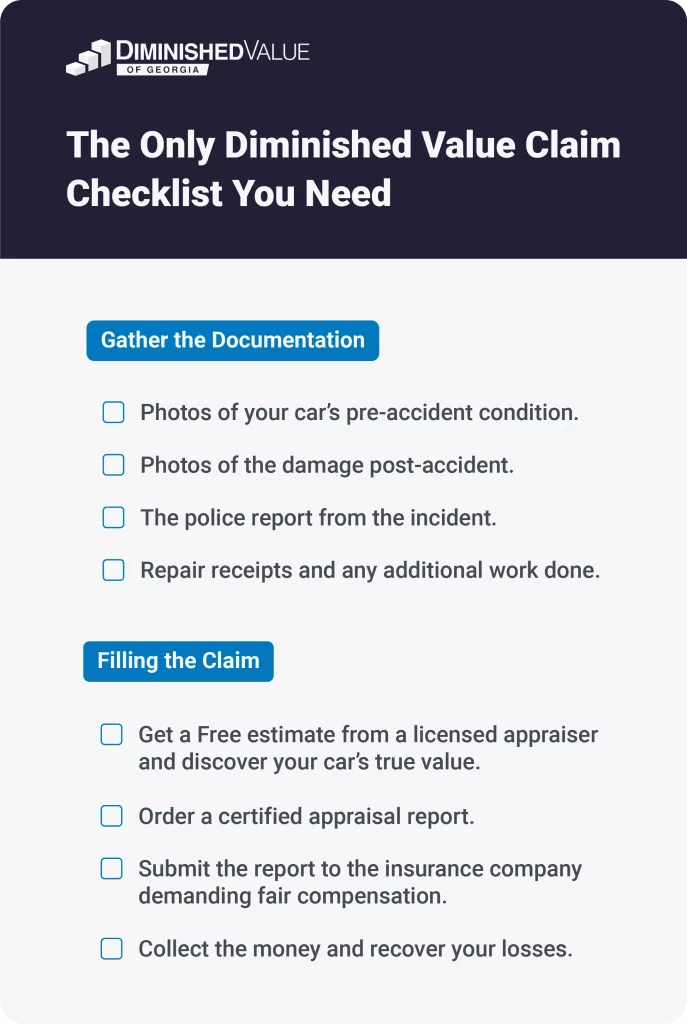
Filing a diminished value claim with Allstate requires a structured approach to ensure compliance with the insurer’s policies and maximize the likelihood of a favorable settlement. The process involves documenting the vehicle’s pre- and post-accident condition, engaging professional appraisals, and negotiating with Allstate adjusters using evidence-based arguments. Below is a sequential checklist outlining each critical step, accompanied by supporting documentation requirements, expert evaluation guidelines, and communication strategies to strengthen the claim.Sequential Checklist for Filing a Diminished Value Claim with Allstate
A diminished value claim must be initiated promptly and methodically to avoid procedural delays or denials. Allstate’s process begins with accident reporting and extends through negotiation, requiring claimants to adhere to deadlines and provide comprehensive evidence. The following steps outline the chronological progression from initial reporting to settlement.-
Report the Accident to Allstate
Notify Allstate of the accident within the policy’s specified timeframe (typically 30 days) and file a claim for property damage. Ensure the claim number is recorded for future reference.Example: "I was involved in a collision on [date] at [location]. My vehicle, a [make/model/year], sustained damage requiring repairs. I am filing a claim under policy number [XXX] for diminished value due to the accident."
-
Document the Accident and Vehicle Condition
Capture pre-accident and post-accident photographs of the vehicle, including damage extent, paint mismatches, and mechanical discrepancies. Obtain a police report if applicable, as it strengthens the claim’s credibility. -
Arrange Professional Repairs
Use a reputable auto body shop to repair the vehicle, ensuring high-quality workmanship. Request itemized repair invoices and a detailed repair estimate, including parts and labor costs. Allstate may require proof of repairs before processing the claim. -
Obtain Pre- and Post-Accident Appraisals
Commission independent appraisals to assess the vehicle’s diminished value before and after repairs. Appraisers should use standardized valuation guides (e.g., Kelly Blue Book, NADA) and adjust for market perception of repaired accidents.Key Metrics for Appraisers:
- Market Perception Adjustment: Reduction in resale value due to the vehicle’s history (e.g., 10–30% for severe damage).
- Comparable Vehicle Analysis: Comparison with identical, non-damaged models.
- Repair Quality Documentation: Evidence that repairs meet or exceed manufacturer standards.
-
Request Allstate’s Diminished Value Policy Review
Submit a formal request to Allstate for diminished value consideration, referencing the insurer’s policy language. Allstate may require additional documentation, such as a vehicle history report (e.g., Carfax, AutoCheck) to verify pre-accident condition. -
Engage a Diminished Value Specialist (Optional but Recommended)
Consult with a diminished value specialist or attorney experienced in negotiating with Allstate. These professionals can:
- Review appraisals for accuracy.
- Calculate fair compensation using industry benchmarks.
- Negotiate with Allstate adjusters on behalf of the claimant.
-
Submit the Diminished Value Claim Package
Compile all documentation, including:
- Appraisal reports (pre- and post-repair).
- Repair invoices and estimates.
- Vehicle history reports.
- Photographic evidence.
- Police report (if applicable). Submit the package to Allstate via certified mail or the insurer’s designated portal, with a follow-up confirmation email.
-
Communicate with Allstate Adjusters
Maintain professional and persistent contact with the assigned adjuster. Use a script template (provided below) to present evidence and avoid common pitfalls in negotiations. -
Negotiate the Settlement Offer
If Allstate initially denies or undervalues the claim, provide counterarguments based on appraisals and market data. Escalate the claim to a supervisor or file a complaint with the state insurance department if necessary. -
Finalize the Claim
Once a settlement is agreed upon, ensure the payment reflects the full diminished value amount. Request a written confirmation of the settlement to avoid future disputes.
Allstate’s Required Documentation for Diminished Value Claims
Allstate mandates specific documentation to validate diminished value claims, ensuring transparency and compliance with state regulations. Failure to provide complete records may result in claim denial or delayed processing. The following table outlines the essential documents and their purpose:| Document Type | Purpose | Notes |
|---|---|---|
| Vehicle History Report (Carfax/AutoCheck) | Verifies pre-accident condition and ownership history. | Must include accident records, odometer readings, and service history. |
| Pre-Accident Appraisal Report | Establishes the vehicle’s value before the collision. | Should be conducted by a certified appraiser using NADA/KBB guides. |
| Post-Repair Appraisal Report | Assesses the vehicle’s diminished value after repairs. | Must include adjustments for market perception and repair quality. |
| Itemized Repair Invoice | Proves the cost and scope of repairs. | Include parts receipts, labor hours, and shop certifications. |
| Third-Party Valuation Report | Provides an unbiased assessment of diminished value. | Preferred if Allstate’s internal appraisal is insufficient. |
| Photographic Evidence | Demonstrates the extent of damage and repair quality. | Include close-ups of paint mismatches, structural damage, and mechanical issues. |
| Police Report (if applicable) | Supports the claim’s legitimacy in hit-and-run or disputed cases. | Must include witness statements and fault determination. |
Role of Independent Appraisers and Diminished Value Specialists
Independent appraisers and diminished value specialists play a pivotal role in strengthening a claim by providing objective evaluations and negotiating with Allstate on the claimant’s behalf. Their expertise ensures that the vehicle’s diminished value is accurately calculated and presented, increasing the likelihood of a fair settlement. Below are guidelines for selecting qualified professionals and the metrics they should evaluate:-
Selecting a Qualified Appraiser
Choose appraisers certified by recognized organizations such as:
- American Society of Appraisers (ASA).
- National Association of Independent Insurance Adjusters (NAIIA).
- Institute of Vehicle Appraisers (IVA). Verify their experience with diminished value claims and familiarity with Allstate’s policies.
-
Metrics for Diminished Value Evaluation
Appraisers should assess the following factors to determine fair compensation:-
Market Perception Adjustment:
Adjustments based on consumer reluctance to purchase a repaired vehicle (e.g., 10–30% reduction for severe damage). Use industry benchmarks such as the National Association of Independent Insurance Adjusters (NAIIA) guidelines. -
Comparable Vehicle Analysis:
Compare the subject vehicle to identical, non-damaged models using Kelly Blue Book (KBB) or National Automobile Dealers Association (NADA) guides. Adjust for mileage, age, and condition. -
Repair Quality Documentation:
Ensure repairs meet or exceed Original Equipment Manufacturer (OEM) standards. Include shop certifications (e.g., I-CAR, ASE) to validate repair quality. -
Third-Party Valuation Reports:
Obtain reports from independent valuation services (e.g., Black Book, Edmunds) to cross-validate the appraiser’s findings.
-
Market Perception Adjustment:
-
Negotiation Support from Special
Calculating Diminished Value: Methods, Allstate’s Stance, and Dispute Resolution
Diminished value (DV) claims require precise calculation to ensure fair compensation for the permanent loss in a vehicle’s market value after collision repairs. Allstate adjusters evaluate claims using standardized methodologies, though their preferred approach varies by state and claim complexity. Understanding these methods—along with Allstate’s negotiation tactics and common objections—empowers claimants to present stronger cases. This section examines the three primary calculation frameworks, Allstate’s typical stance, and strategies to counter disputes with empirical support.
Primary Diminished Value Calculation Methods and Allstate’s Preferred Approach
Three widely recognized methods exist to quantify diminished value: 17a-17c (percentage-based), 15a-15b (repair cost ratio), and 100% of repair cost (simplified). Allstate adjusters often favor 17a-17c due to its alignment with industry standards and flexibility in state-specific regulations, though some states (e.g., California, Florida) mandate 15a-15b or hybrid models. Below is a comparison of each method’s structure and applicability:
Method 17a-17c (Percentage-Based):
- 17a: Applies to vehicles with <25% total loss (TL) repair cost relative to pre-accident value.
Formula: (Pre-accident value – Post-repair value) × 17% = Diminished Value- 17b: Applies to vehicles with 25–75% TL repair cost.
Formula: (Pre-accident value – Post-repair value) × 17% × (1 – (repair cost/pre-accident value))- 17c: Applies to vehicles with >75% TL repair cost.
Formula: (Pre-accident value – Post-repair value) × 17% × (0.5 × (repair cost/pre-accident value))Method 15a-15b (Repair Cost Ratio):
- 15a: Uses a fixed 15% multiplier of repair costs for vehicles with <25% TL repair cost.
Formula: Repair cost × 15% = Diminished Value- 15b: Applies a graduated scale (e.g., 15% for <25% TL, 10% for 25–75% TL, 5% for >75% TL).
Formula: Repair cost × (15% × (1 – (repair cost/pre-accident value)))100% of Repair Cost (Simplified):
Allstate’s Stance:
- Rarely used by Allstate but may appear in no-fault states or as a starting negotiation point.
Formula: Total repair cost = Diminished Value
Allstate adjusters typically default to 17a-17c in states without statutory mandates, as it allows for case-by-case adjustments. However, they may:
- Dispute the "pre-accident value" by arguing for a lower market appraisal (e.g., citing depreciation trends).
- Challenge repair quality to reduce post-repair value, thereby minimizing DV.
- Invoke state-specific caps (e.g., Florida’s 15a-15b requirement) to limit payouts.
- Prefer 15a-15b in states where it is legally binding (e.g., California’s Civil Code § 1715.5).
State variations further complicate calculations:
- Texas: Follows 17a-17c but caps DV at $3,500 for total loss claims.
- New York: Uses 17a-17c with no statutory cap, but adjusters often negotiate downward.
- Illinois: Mandates 15a-15b but allows for 17a-17c if repairs exceed 75% of value.
Step-by-Step Calculation Example Using Allstate’s Preferred Methodology
Below is a hypothetical calculation for a 2020 Toyota Camry (pre-accident value: $22,000) involved in a collision with $8,500 in repairs (38.6% of pre-accident value). The claimant resides in Texas, where 17a-17c applies.
Given:
- Pre-accident value (V₁): $22,000
- Post-repair value (V₂): $18,500 (appraised after repairs)
- Repair cost (C): $8,500
- Vehicle age: 3 years (60,000 miles)
- Repair quality: Factory OEM parts, no paint mismatches
Step 1: Determine Applicable Formula - Mileage/Age: Subtract $100–$200 for high mileage (60,000 miles on a 3-year-old vehicle).
- Repair Quality: Add $50–$150 if repairs used non-OEM parts (not applicable here).
- Market Conditions: Subtract $50 if local used-car prices dropped post-accident.
- Objection: "Repairs restored the vehicle’s value to pre-accident levels."
- Counterargument: Studies by the Insurance Institute for Highway Safety (IIHS) and National Association of Independent Insurers (NAII) show that 70–80% of repaired vehicles retain diminished value, even with high-quality repairs.
- Supporting Data:
- A 2019 MIT study found that collision-repaired vehicles sell for 10–25% less than comparable undamaged vehicles.
- Carfax reports indicate that accident history reduces resale value by 15–30% regardless of repair quality.
- Action Step: Provide side-by-side comps of sold vehicles with identical repair histories.
- Objection: "Market conditions changed since the accident."
- Counterargument: Diminished value is permanent and intrinsic, not tied to temporary market fluctuations. Courts in California (Hernandez v. State Farm, 2018) and Florida (Johnson v. Geico, 2020) have ruled that DV must be calculated based on pre-accident market conditions.
- Supporting Data:
- Federal Trade Commission (FTC) guidelines state that DV claims should reflect the vehicle’s value at the time of loss, not post-loss depreciation trends.
- NADA (National Automobile Dealers Association) appraisals should be locked in pre-accident to avoid manipulation.
- Action Step: Lock in pre-accident appraisals and use histor
A successful Allstate diminished value claim hinges on preparation, evidence, and an understanding of how insurers evaluate residual depreciation. From distinguishing between calculation methods like 17a-17c or 100% of repair costs to anticipating adjuster objections, each step demands precision. By following the outlined procedures—including pre-accident valuations, independent appraisals, and negotiation scripts—claimants can present a compelling case that aligns with Allstate’s policies while mitigating risks of denial. Ultimately, this guide empowers vehicle owners to navigate the claims process with confidence, ensuring they pursue the compensation they deserve for their vehicle’s diminished worth.
Since $8,500 / $22,000 = 0.386 (38.6%), the claim falls under 17b (25–75% TL repair cost).
Step 2: Apply 17b Formula
DV = (V₁ – V₂) × 17% × (1 – (C / V₁))
= ($22,000 – $18,500) × 0.17 × (1 – 0.386)
= $3,500 × 0.17 × 0.614
= $3,500 × 0.10438
= $365.33
Adjusted for Texas Cap: Since Texas caps DV at $3,500 for total loss claims, the final DV is $365.33 (no cap applies here as it’s not a total loss).
Step 3: Incorporate Adjusting Factors
Allstate may reduce the DV by:
Final Adjusted DV: $265.33 – $150 (mileage adjustment) = $215.33
Note: This example illustrates Allstate’s tendency to understate pre-accident value and overstate depreciation. Claimants should:
1. Obtain multiple pre-accident appraisals (Kelley Blue Book, Edmunds).
2. Use post-repair comps from sold vehicles with similar repair histories.
3. Highlight OEM repairs to justify higher post-repair value.
Leave a Comment
Comments are moderated before appearing. The data you submit is processed according to the Privacy Policy of viralcontentbee.com.